


 Insight TOP
How Can We Create PR That Resonates Globally? — Understanding Global PR Through the “7Cs”
Insight TOP
How Can We Create PR That Resonates Globally? — Understanding Global PR Through the “7Cs”

How Can We Create PR That Resonates Globally? — Understanding Global PR Through the “7Cs”
 2026.09.28

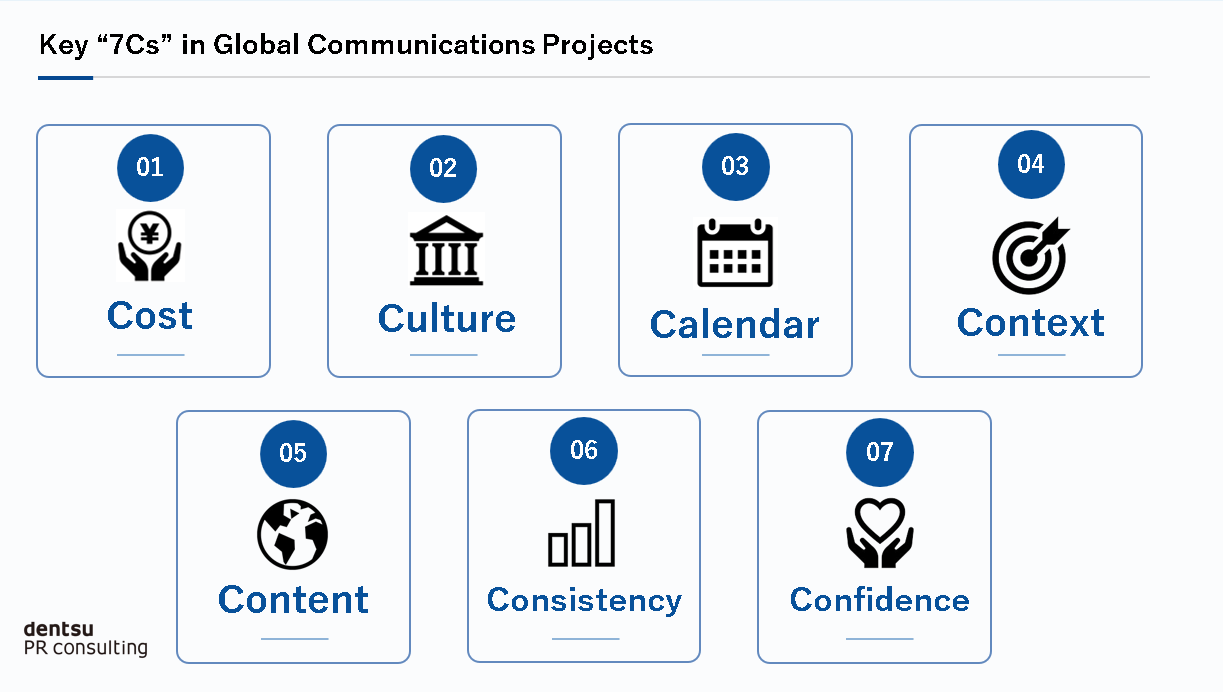
In our previous article, we introduced the “3Cs” that form the foundation of global PR: Cost, Culture, and Calendar. (See our previous article here.)
However, when putting global PR into practice, there are additional perspectives that communications professionals need to keep in mind. What kinds of challenges do companies face in the field, and what should guide their PR and communications activities for overseas audiences?
Continuing from our previous article, Nanami Kanda, a Gen Z employee, interviews Tatsunori Abe of our Global Business Department, who has worked in the field of global PR for many years.
Through their conversation, we introduce an advanced framework for global PR that has emerged from practical experience in the field.
This article was originally published in Japanese and has been translated into English.
Interviewer Profile

Nanami Kanda
Global Business Department, Dentsu PR Consulting Inc.
Nanami Kanda has academic and professional experience in the United States. After working at a Japanese government-affiliated organization in New York, she joined Dentsu PR Consulting in 2025.
She works on global PR projects in both directions: supporting Japanese companies engage with audiences overseas and assisting international companies and organizations in communicating with stakeholders in Japan. Drawing on her Gen Z perspective and international experience, she provides communications support to a wide range of clients in Japan and abroad.
Interviewee Profile

Tatsunori Abe
Planning Director, Global Business Department, Dentsu PR Consulting Inc.
With over 30 years of experience in public relations, Tatsunori Abe specialize in strategic consulting to his work, primarily in the field of global communications. His expertise also spans wide range of PR areas such as digital communications and crisis management, with a particular focus on supporting Japanese and international companies in their overseas expansion.
Introduction
Nanami Kanda (Nanami):
The “3Cs of global PR” that you introduced in our previous article provided a very easy-to-understand framework for learning the fundamentals of global PR.
I understand that there is also a more advanced framework called the “7Cs of global PR,” which provides a more practical perspective. Please tell us more about that this time!
Tatsunori Abe (Nori):
There are actually seven Cs in the global PR framework. If the three Cs we introduced previously—Cost, Culture, and Calendar—form the foundation of global PR, the remaining four Cs that I am going to discuss are more practical and advanced perspectives for generating results through communications. (See our previous article here.)
Although each of these elements can be considered independently, they are also closely interconnected. Even if you have not yet had the opportunity to work directly on a global PR project, simply keeping these ideas in the back of your mind can significantly change the way you look at global PR. Let me explain them one by one.
(4)Context
Nori:
First is Context. In global PR, Context means connecting information about a product or service with the issues and changes affecting society, the industry, and people’s lives, and showing why this information is worth communicating now.
For example, simply saying, “We launched a new product,” “We focused on making it taste better,” or “We made it more affordable” may not be enough for overseas media or stakeholders to understand why the news is important. It is therefore essential to communicate not only information about the product itself, but also the background behind its development, changes taking place in society, and the role the company intends to play within that broader environment.
One approach that makes effective use of Context is thought leadership. Thought leadership refers to companies or business leaders sharing their expertise and distinctive perspectives in order to introduce new ideas, discussions, or directions for an industry or society. Rather than simply promoting their own products, companies can build credibility and strengthen their presence in a particular field by expressing their views on issues that society or the industry needs to address.
Specific information such as product features, pricing, and ingredients is of course important. In global PR, however, companies are also expected to communicate the broader background: “Why are we providing this product?” and “Why is this initiative necessary now?” Communicating products and services together with the issues behind them and the company’s intentions is precisely why Context matters.
(5)Content
Nori:
Next is Content. When it comes to Content, clarity is key.
Today, corporate communications are no longer limited to traditional news releases consisting mainly of text and photographs. Companies increasingly use short-form videos, reels, carousel posts, and other formats to communicate key points clearly and visually. With audiences surrounded by an enormous amount of information, companies need to carefully consider both their messages and the way those messages are presented so that people can understand them quickly.
One reason clarity is especially important in global PR is the diversity of linguistic and cultural backgrounds among audiences. Japan has a relatively homogeneous cultural and linguistic environment and one of the highest literacy rates in the world. As a result, there is often a shared foundation that makes even relatively complex explanations easier to understand. The situation can be very different overseas. The United States, for example, is a highly multicultural and multiethnic society, and many people use both English and Spanish. Even within the same country, people may have very different life experiences, cultural backgrounds, levels of education, and values. It is therefore far from easy to view all of these people as a single target audience and create one message that resonates equally with everyone.
That is why the first priority should be creating simple and clear content that people from different backgrounds can easily understand. By making the key message intuitive regardless of someone’s region, first language, or prior knowledge, information can reach a broader range of people across society.
In global PR, success is determined not by how much information you communicate, but by how clearly you communicate it. Transforming complex information into a form that anyone can understand is what makes good content.
(6)Consistency
Nori:
The sixth C is Consistency.
Over the years, I have supported the overseas communications activities of many Japanese companies, and relatively few have been able to maintain the same core communications theme over a long period of time. Even after launching a new initiative, some companies change their theme or direction—or stop communicating altogether—when they do not see the results they expected within a short period of time.
However, awareness of and trust in a company or brand are not created through a single communication effort. By consistently communicating what the company values and what kinds of issues it is working on to address, companies can gradually deepen understanding among stakeholders in their target markets. That is why one piece of advice I often give is, “Once you start, don’t stop too easily.”
Of course, this does not mean repeating exactly the same content or using exactly the same methods indefinitely. While maintaining a consistent core theme and set of values, companies should continue refining their messaging, angles, and methods of communication in response to audience reactions and changes in the surrounding environment. Knowing what should change and what should remain unchanged is itself part of consistency. This principle applies not only to companies, but also to individuals such as business leaders and experts. Many executives and specialists overseas have careers, activities, and communications that are connected by a clear and consistent theme. This makes it easy to understand why this particular person is speaking about this particular issue. That accumulation of experience and communication strengthens both their credibility and their authority to speak on a given subject.
In global PR, Consistency is not simply about continuing to communicate. It means adapting to change while maintaining a clear sense of who you are and steadily building up words and actions that remain aligned with that core identity. That consistency becomes an important asset supporting trust in both organizations and individuals.
(7)Confidence
Nori:
The final C is Confidence. In fact, it may be the most important element when competing with companies in overseas markets and strengthening your presence globally.
Japanese business culture tends to place great value on humility and cooperation. As a result, companies sometimes hesitate to strongly promote their own achievements or strengths, focusing instead on what they still need to improve rather than what they already do well.
In overseas business environments, including those in Europe, the United States, and other parts of Asia, there are many situations in which companies are expected to communicate their expertise and opinions clearly and confidently. In meetings, business negotiations, and media interviews, clearly expressing what perspective your company brings and what value it can provide is often the first step toward gaining trust.
In Japan today, a rather negative self-perception has become widespread amid prolonged economic stagnation, as reflected in expressions such as the “lost three decades.” However, when doing business overseas, we are sometimes surprised by the gap between that self-perception and the way Japan is viewed internationally.
People outside Japan often have far more interest in and respect for Japan than we ourselves may realize. Many people want to experience Japan for themselves, and aspects of Japanese society that we may take for granted—its culture, safety, and social stability—are considered extremely valuable and, in many ways, rare from a global perspective.
Of course, Japanese companies still have much to learn and many things to change if they are to succeed in global markets. At the same time, Japan already possesses the appeal and competitiveness to be highly valued on the global stage. If those qualities can be communicated effectively, I believe Japanese companies still have enormous potential.
After spending many years introducing Japanese companies to global markets, one thing I feel strongly is this: There are still many Japanese companies with the potential to transform dramatically simply by becoming better known.
Japan is home to a large number of companies with excellent products, services, and technologies. However, no matter how good a product or service may be, it has little chance of being chosen if people do not recognize its value.
In addition to creating good products and services, companies need to communicate their strengths effectively and make sure people know about them. If they can do that, I believe Japanese companies still have considerable room for growth in global markets.
We share that belief, and through our daily work in global PR, we support companies as they take on new challenges. We look forward to working together with our clients to help Japanese companies gain the recognition they deserve around the world and realize their full potential.
Conclusion
Nanami:
Thank you. We now have the complete picture of the 7Cs…
Each idea sounds very simple on its own, but once you actually try to translate these principles into communications initiatives, it becomes surprisingly difficult.
At the same time, what you said about the importance of having confidence really resonated with me personally because of my own experience working in the United States. Japanese companies may have many strengths that even we ourselves have not fully recognized yet.
I believe our role is to uncover those strengths and translate them into concrete communications initiatives—and that this is also what is expected of truly outstanding PR professionals. I hope I can become one of them as soon as possible!