

 Insight TOP
What are the “3Cs” of Global PR? ーGen Z Perspective on Global Communications, in Conversation with a Seasoned PR Professional
Insight TOP
What are the “3Cs” of Global PR? ーGen Z Perspective on Global Communications, in Conversation with a Seasoned PR Professional

What are the “3Cs” of Global PR?
ーGen Z Perspective on Global Communications, in Conversation with a Seasoned PR Professional
 2026.08.03

As more Japanese companies expand their businesses overseas, many are also facing challenges in conducting effective PR and communications activities in international markets.
Global PR requires an understanding of media environments, cultures, and values that differ significantly from those in Japan. As a result, companies often come to us with concerns such as, “We don’t know where to start,” or “The approaches that worked in Japan do not necessarily work overseas.”
For this article, Nanami Kanda, a second-year Gen Z employee, interviews Tatsunori Abe of our Global Business Department, who has worked in the field of global PR for many years.
Through their conversation, we introduce the “3Cs,” a set of fundamental perspectives essential to global PR, for companies and communications professionals considering overseas expansion.
This article was originally published in Japanese and has been translated into English.
Interviewer Profile

Nanami Kanda
Global Business Department, Dentsu PR Consulting Inc.
Nanami Kanda has academic and professional experience in the United States. After working at a Japanese government-affiliated organization in New York, she joined Dentsu PR Consulting in 2025.
She works on global PR projects in both directions: supporting Japanese companies engage with audiences overseas and assisting international companies and organizations in communicating with stakeholders in Japan. Drawing on her Gen Z perspective and international experience, she provides communications support to a wide range of clients in Japan and abroad.
Interviewee Profile

Tatsunori Abe
Planning Director, Global Business Department, Dentsu PR Consulting Inc.
With over 30 years of experience in public relations, Tatsunori Abe specialize in strategic consulting to his work, primarily in the field of global communications. His expertise also spans wide range of PR areas such as digital communications and crisis management, with a particular focus on supporting Japanese and international companies in their overseas expansion.
Introduction
Nanami Kanda (Nanami):
We are launching a new article series on global PR! In this series, I will interview Nori, who has many years of experience in global PR, from the perspective of a Gen Z employee. Through these conversations, I hope to explore key topics in depth and share useful insights with companies considering overseas expansion.
Tatsunori Abe (Nori):
It’s exciting to launch this new series, and I’m really looking forward to it. We have been receiving more and more inquiries about global PR. Regardless of the size of the company, many organizations seem to face similar challenges. I hope we can share some of the key points and provide at least one practical takeaway for our readers.
Nanami:
Absolutely. As a member of the Global Business Department, I work on global PR projects for Japanese and non-Japanese companies every day. Through this work, I often feel that many companies share common concerns and questions about communicating with their overseas audiences. So, for this first article, I would like to ask you about the basic principles of global PR. Please make it easy to understand!
What are the “3Cs” of Global PR?
Nori:
Let me start with a question. Have you heard of the “3C analysis” framework often used in marketing? It is a method of analyzing the business environment from three perspectives: Customer, Competitor, and Company. Separately from that, I believe there is another set of “3Cs” that is essential in global PR. Those three Cs are Cost, Culture, and Calendar.
When people think of global PR, many first imagine the language barrier. In reality, however, understanding these three factors can have a major impact on whether a global PR project succeeds or not. Let me explain them one by one.
Cost
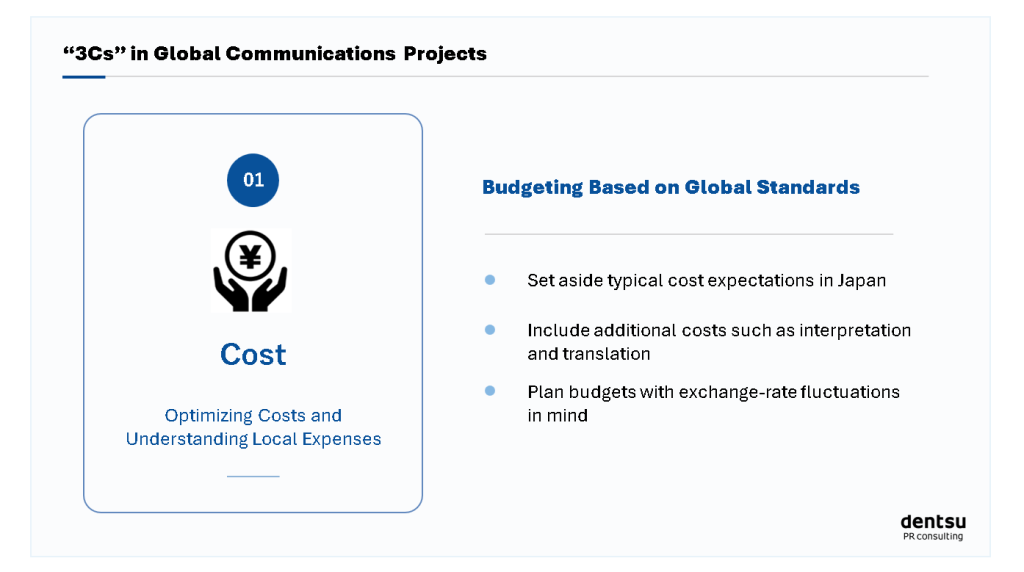
First, let’s talk about cost. It is important to set aside domestic Japanese budget standards when thinking about global PR.
In many Japanese companies, sufficient budgets are not always allocated even for domestic PR activities. If companies approach global PR as a simple extension of their domestic PR activities, they may quickly face a budget gap and be taken aback, thinking, “Is this really all we can achieve with a budget of this size?”
This is especially true today, as the weak yen can make overseas activities more expensive than expected when estimated based on Japanese cost assumptions. Global PR also requires additional costs that do not usually arise in domestic PR activities, such as interpretation and translation fees, as well as costs for coordination with local partners.
For this reason, if I am asked, “What is the most important factor in implementing global PR?” my first answer is securing an appropriate budget. It may sound like an inconvenient truth, but in practical terms, having the right budget is what makes it possible to execute the necessary initiatives at the required scale and quality.
Culture
Next is culture. This may be the easiest point for readers to imagine.
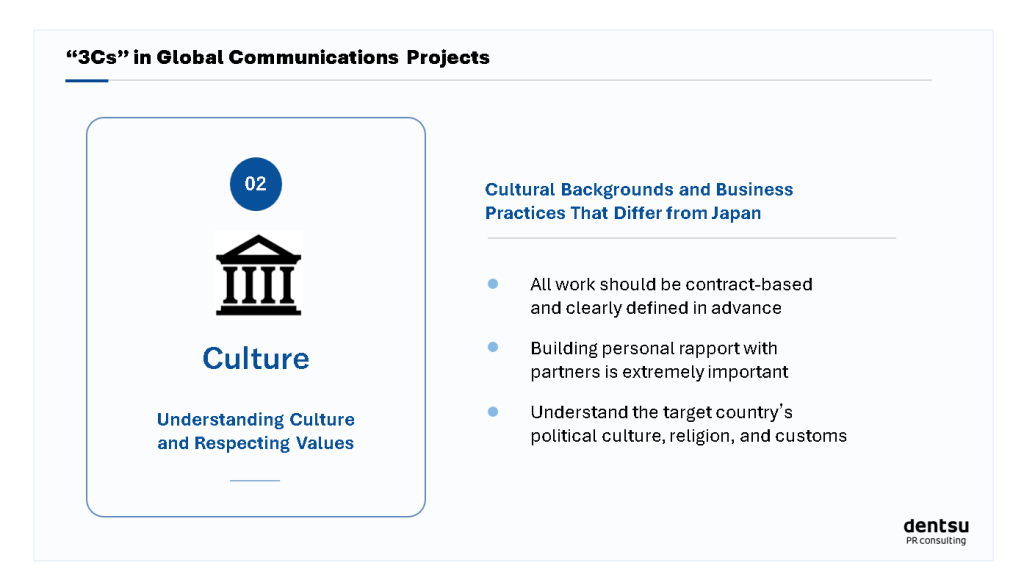
Differences in language, politics, regulations, religion, and everyday customs can create significant differences in people’s values and behaviors. What PR professionals need to understand is how these cultural backgrounds influence the local media landscape and the way communication works in each market.
Take press conferences, for example. The situation can vary greatly depending on the country or region. In some parts of the Middle East, the participation of government officials or influential stakeholders can significantly affect media attendance and the overall turnout. In markets such as China and Vietnam, government oversight and regulations around reporting and information dissemination tend to be relatively strong, and certain confirmation processes may be required before an article is published.
In this way, differences in culture, politics, and social systems can significantly affect how companies engage with the media and how information is communicated. For companies and communications professionals aiming to expand overseas, it is essential to properly understand the media landscape of each market.
This is not limited to the PR industry, but in many overseas markets, contracts are generally taken very seriously. The scope of work, deliverables, and responsibilities are clearly defined in contracts, and additional fees are incurred when work outside the agreed scope arises.
In Japan, there are many cases where agencies and service providers try to respond flexibly to client requests, even if those requests go beyond the original contract scope. This flexibility is sometimes valued as part of the sincerity and dedication often associated with Japanese business culture. Overseas, however, it is more common to proceed based on the contract first. Of course, when a long-term relationship of trust has been established, flexible responses may still be possible. Even so, the distinct balance between “contracts” and “relationships” is a key cultural difference between Japan and international markets.
Calendar
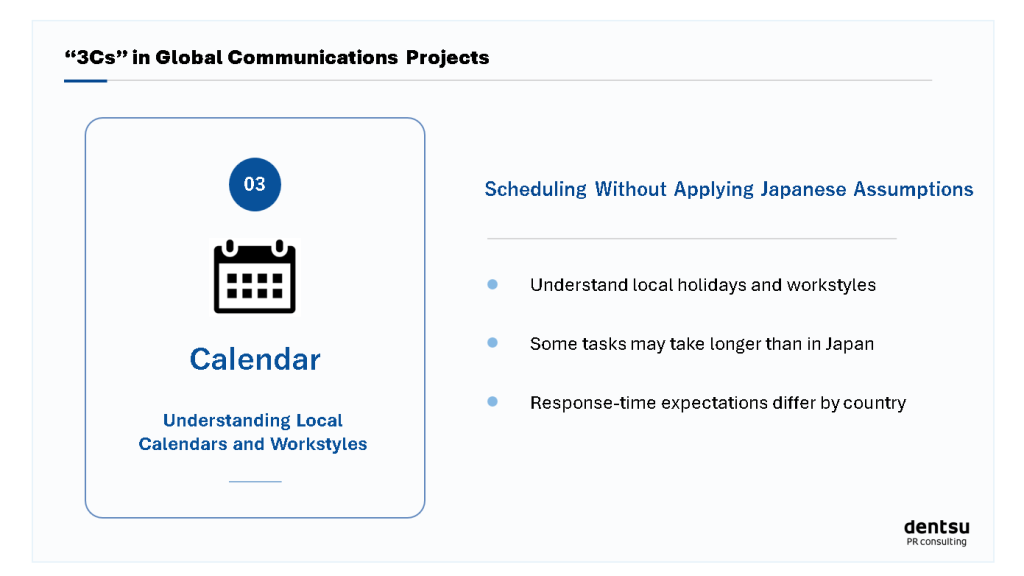
The final C is calendar. This is closely related to culture, but understanding each country’s holidays, major national events, and seasonal customs can provide important clues for PR activities.
In Japan, many PR initiatives are designed around seasonality. The same applies overseas. It is important to understand and respect traditions and events rooted in local culture. In fact, by incorporating them effectively, companies can create communications that feel more relatable to local consumers and media.
From a calendar perspective, it is also extremely important to understand local workstyles. Japanese people are often seen as working long hours by global standards. In many other countries, however, personal time and family time are generally given higher priority.
For example, in Europe and other regions, taking extended vacations is common, and some people may take several weeks to around a month off during the summer. As a result, it is not unusual for key project members or client contacts to become unavailable for a period of time. In many countries in the Middle East, Friday is the day of Islamic congregational prayer, and the weekend often falls on Friday and Saturday. In India, even within the same country, holidays can vary significantly depending on region and religion, so careful attention is required when coordinating schedules.
By understanding the daily rhythms and workstyles of people in each local market, it becomes easier to make decisions such as, “We should avoid holding an event during this period,” or “If we want to make an announcement at this timing, when should we start preparing?”
In global PR, understanding the local calendar is not simply a matter of schedule management. It is an important factor that directly affects smooth project management and the building of strong working relationships.
Nanami:
The “3Cs of global PR” are very fundamental, yet they are also important points that differ significantly from domestic PR. I can really see how complex global PR can be, since the points to keep in mind vary from country to country.
Nori:
That’s right. Even if we understand it intellectually, once we actually practice global PR, we realize differences in business environments and commercial customs in many different situations. I believe the first step in global PR is to recognize and respect the fact that “we are different.”
The 3Cs are points we share with client companies at the beginning of global PR projects. Recently, however, I have also started to feel that it is important to understand the “7Cs of global PR” as a more advanced version of this framework.
Nanami:
Not 3Cs, but 7Cs! That means there are even more elements we need to pay attention to. Please tell us more!
To be continued in Part Two…
Editor’s Note
Learning about the “3Cs of global PR” reminded me that global PR is not something completely special or separate from other forms of communication. Rather, it is about pursuing the most fundamental principle of communication: understanding the other party.
Before thinking about “what to communicate,” it is essential to understand “who we are communicating with” and “under what circumstances we are communicating.”
Personally, when I look at PR initiatives that attract attention overseas, I sometimes wonder, ‘Why would it be so difficult to execute something like this in Japan?’ or ‘Why don’t Japanese companies implement similar initiatives?” Looking back through the lens of this interview, I realized that many of the answers lead back to the 3Cs: Cost, Culture, and Calendar.
In the next article, we will take a deeper look at the evolved framework of the “7Cs of global PR.” We hope you will look forward to it.