



Pride Month: What Should Brands Stand For? — Avoiding Pinkwashing and Pink-Hushing
 2026.06.17
June is widely recognized around the world as “Pride Month,” a time to reflect on and promote greater understanding and inclusion of LGBTQ+ communities (lesbian, gay, bisexual, transgender, queer, and other diverse identities).
In Japan as well, related events and initiatives have been steadily increasing. Against this backdrop, what is increasingly expected of brands is not simply to express support, but to demonstrate—through both words and actions—a stance that is consistent with their values and aligned with their broader business practices.
How, then, should brands engage with this topic?
In this article, using Pride Month as a lens, we explore what sincere and responsible communication looks like from a public relations perspective.
Pride Month traces its origins to the Stonewall Riots (June 28, 1969, New York City)—a pivotal moment that sparked the modern movement for LGBTQ+ rights. Today, Pride Month has become a symbolic period for celebrating diversity and promoting inclusion.
What were the Stonewall Riots?
The Stonewall Riots refers to a series of protests that began at the Stonewall Inn, a gay bar in New York’s Greenwich Village, in response to a police raid.
At the time, same-sex relationships were heavily stigmatized, and police crackdowns on gay bars were common. For the first time, members of the LGBTQ+ community collectively resisted, leading to several days of protests.
This event is widely regarded as the starting point of the modern LGBTQ+ rights movement and the origin of today’s Pride movement.
In Japan as well, Pride Month has gained increasing visibility in recent years, with events and corporate initiatives expanding nationwide. Among them, Tokyo Pride (held annually in Yoyogi Park, Tokyo) is known as one of the largest LGBTQ+ events in Japan and Asia, attracting over 270,000 participants in 2026—an indication of its growing social impact.
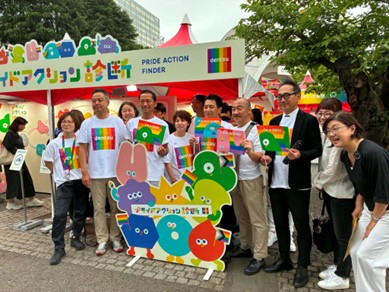
Senior leaders from dentsu Japan companies gather at dentsu’s Tokyo Pride booth in 2026.
In such settings, the role of companies and brands goes beyond sponsorship or visibility. These moments serve as an opportunity to demonstrate how businesses communicate their values and stance to society—in other words, they test the essence of public relations itself.
To consider how brands should engage with this topic, two key concepts cannot be overlooked: “pinkwashing” and “pink-hushing.”
What Is Pinkwashing?
As more companies express support for LGBTQ+ communities, “pinkwashing” has emerged as an important concept in corporate communication.
According to Tokyo Rainbow Pride (a nonprofit organization in Japan promoting LGBTQ+ awareness), pinkwashing refers to criticism of attempts by organizations to conceal negative aspects—such as human rights issues—by presenting themselves as LGBTQ+-friendly.
The term is also sometimes used interchangeably with “rainbow washing,” describing situations in which companies or brands appear to support LGBTQ+ communities but fail to back this up with meaningful actions or internal alignment.
Pinkwashing may occur intentionally, but it can also arise unintentionally—for example, when companies aspire to take action but fall short due to limited resources or insufficient internal alignment.
Why “Pink”?
The term “pink” originates from the pink triangle, a symbol imposed on gay men (including bisexual men and transgender women at the time) during persecution under Nazi Germany.During the Holocaust, individuals sent to concentration camps were forced to wear badges for identification.
- Gay men were marked with an inverted pink (lavender) triangle
- Women labeled as “asocial” (including lesbians) were marked with a black triangle
Originally a symbol of oppression and discrimination, the pink triangle was later reclaimed by LGBTQ+ communities as a symbol of resistance and pride. Today, pink—alongside the rainbow flag—is widely recognized as a symbol of LGBTQ+ identity.
Even if brands use rainbow colors in products or campaigns, without meaningful internal policies or actions, they risk undermining trust.
What is required is not superficial expression, but communication grounded in substance and aligned with a brand’s values and practices.
The Other Risk—Pink-Hushing
In recent years, another trend has emerged: “pink-hushing.”
Pink-hushing refers to situations where companies refrain from communicating or engaging in LGBTQ+ initiatives due to excessive fear of being criticized for pinkwashing.
Similar to the rise of “greenhushing” in environmental issues, this tendency is increasingly observed in the human rights domain.
However, remaining silent on social issues may itself be perceived as indifference or a lack of commitment.
Transparency and Integrity Over Perfection
How, then, can brands communicate without falling into either pinkwashing or pink-hushing?
The key is not perfection.
The public does not necessarily expect companies to have flawless systems or complete solutions.
What matters instead is transparency—openly communicating both achievements and ongoing challenges—and demonstrating a genuine commitment to continuous improvement.
In other words, communication grounded in transparency and integrity is essential to building trust.
The Risk of Unintended Offense
At the same time, communication around LGBTQ+ issues carries the risk of unintentionally offending some audiences..
Expressions shaped by lack of knowledge, unconscious bias, or assumptions—even when well-intentioned—may be perceived as exclusionary or insensitive by those directly affected.
Such unintentional discrimination is a critical consideration in corporate communication.
To address this, it is important to engage directly with the voices and experiences of LGBTQ+ individuals, and to foster ongoing learning rather than one-off training.
These continuous efforts contribute to more appropriate and trusted communications.
DEI as a Business Imperative
Efforts related to LGBTQ+ inclusion should not be treated merely as CSR or add-on activities disconnected from core business operations. They are, in fact, a strategic business issue tied to sustainable growth.
Initiatives in DEI (Diversity, Equity & Inclusion) contribute to:
- stronger employee engagement
- enhanced talent acquisition
- increased brand value
Furthermore, with the rapid expansion of impact investing (investment that seeks both financial returns and measurable positive social/environmental impact), companies—especially listed firms—are increasingly expected not only to demonstrate effort, but also to clearly communicate the impact they generate.
According to the Global Impact Investing Network (GIIN), the global impact investing market has grown steadily since 2020, with an average annual growth rate of approximately 15–20% between 2020 and 2024. In Japan as well, interest is rising, with investment assets reaching approximately ¥18.6 trillion by FY2025.
At dentsu Japan, we provide tailored support based on our clients’ challenges, including:
- communication strategy design in DEI areas (including LGBTQ+)
- educational seminars
- development of communication and content strategies
For more information or consultation, please feel free to contact us.


