



The future of corporate museums as a PR asset #14 Cupnoodles Museum
 2023.07.26
 2026.05.23
Corporate museums are part academic and business and occupy the grey zone in between. It is an organization that works with several departments in a company including public relations, branding, advertising, and HR. This series aims to look at the role, function, and future of museums run by corporations through interviews with PR professionals.
Exploring Momofuku Ando’s Legacy at the Cupnoodles Museum
Companies generally have histories that need reflection.

Yasuhiro Kunimi, Dentsu PR Consulting
Introduction
Momofuku Ando, the founder of Nissin Foods, invented Chicken Ramen and Cup Noodles and changed the world’s food culture with his instant noodles. In honor of this great achievement, Nissin Foods Holdings and the Ando Foundation, which Momofuku Ando established with his private funds, operate the Cupnoodles Museum Osaka Ikeda to convey to the next generation his achievements and the joy of invention and discovery. This article delves into the museum’s efforts to create fans over the medium- to long-term, with the passing down of the founder’s spirit as the starting point.
A hands-on, experience-based food education museum located in the birthplace of instant noodles
Ikeda City, Osaka Prefecture, where the Cupnoodles Museum Osaka Ikeda is located, is where Momofuku Ando, founder of Nissin Foods, invented the world’s first instant noodles, Chicken Ramen. The museum was established in 1999, which also marks the 40th anniversary of Nissin Foods’ founding. It is a hands-on food education museum located in the birthplace of instant noodles to honor the founder’s achievements and to convey the history of instant noodles and the importance of its invention and discovery to the next generation.
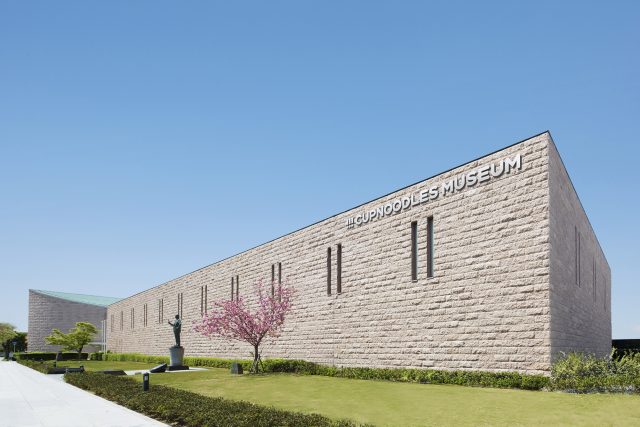
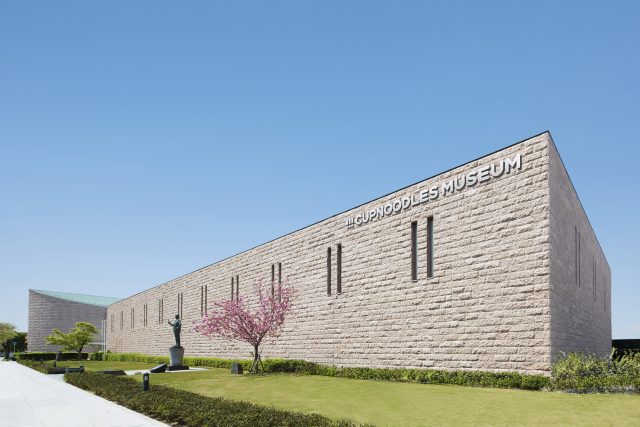
The Cupnoodles Museum Osaka Ikeda (Photo courtesy of Nissin Foods Holdings Co., Ltd.)
The museum’s main target is children, who will lead the next generation. Since its opening, the number of visitors has steadily been increasing, and the museum is so popular that the total number of visitors exceeded 10 million as of March 2021. Around 910,000 people visited during FY 2018, and despite temporary closure between 2021 and 2022 due to the spread of COVID-19, some 210,000 people have visited over these last two years.
The museum is now a vast site of 3,423 square meters. However, it was less than half that size when first established. There was only an exhibition room and a seminar room on the second floor where bookings were accepted for people to participate in a workshop where they could make Chicken Ramen from scratch. The museum was expanded in 2004 and 2015, adding a permanent exhibition area for hands-on workshops.
The Cupnoodles Museum Yokohama was established in 2011, with the hopes that more people could learn about Cup Noodles and the founder’s philosophy. The Cupnoodles Museum Hong Kong opened in 2021 and is known by many people at home and abroad. Yokohama ranked first in 2021 as a corporate museum in Japan, with the greatest number of visitors in 2021, and Osaka Ikeda ranked third*. It is fair to say that the Cupnoodles Museums are the most well-known corporate museums in Japan.
*Source: Japan Amusement and Recreation Park Data Book 2021.
Chicken Ramen changed the world’s food culture
Instant noodles were invented in Japan. According to the World Instant Noodles Association (WINA), 118.2 billion servings are now consumed annually worldwide, and it has become a truly universal food. The astronaut Soichi Noguchi became the first person to eat it aboard the International Space Station when he traveled into space on the Space Shuttle in 2005.
After World War II, Japan faced a dire food shortage, and there was no end to the number of people who collapsed or died on the streets from malnutrition. Momofuku Ando saw people standing in line for a bowl of ramen at the black market near Osaka Station in the cold weather and realized that Japanese people truly loved noodles and that there was great potential for a huge market. About a decade later, when Ando had lost most of his fortune due to business failure, he recalled the lines of people he had seen at the ramen stands at the black market and thought how happy they would be if there were ramen noodles they could stock at home and enjoy whenever they wanted. This was how he came to develop the world’s very first instant noodle product.
He began development single-handedly in a work shed he built in his backyard, and it was a seemingly endless effort. Ando had no experience in noodle-making, and he would make mountains of prototypes only to throw them away. One day, when he was having trouble in trying to find a way to dry noodles, he happened to see his wife frying tempura for dinner, which gave him the idea of frying noodles in oil and drying them. That was how he developed the flash frying and drying method which would become the basic production technology for instant noodles. Further development led to the launch of the world’s first instant noodles, Chicken Ramen, on August 25, 1958.
Interestingly, this great invention was created using common household utensils, except for a second-hand noodle-making machine and a large wok for frying noodles.
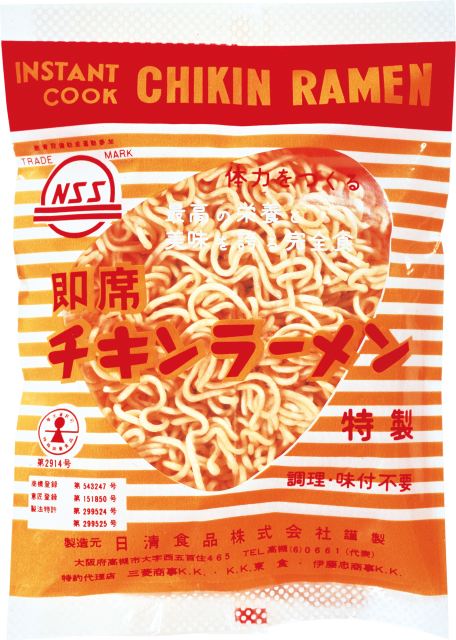
Chicken Ramen at its launch (Photo courtesy of Nissin Foods Holdings)
A place to learn and relive the joys of invention and discovery
“Inventions start with inspiration. Inspiration comes from persistence. No invention is possible without persistence.” These are the words spoken by Momofuku Ando. He had been involved in various businesses since his early years, based on his desire to find something “useful for others” and “to brighten up the world.” He came up with his great invention, Chicken Ramen, at the age of 48—almost retirement age at the time.
“Something one sees is immediately forgotten. But one never forgets enjoyable first-hand experiences, making it meaningful to create an interactive museum.” This quote from Momofuku Ando sums up the essence of the Cupnoodles Museum.
The interactive museum was considered unique and one-of-a-kind when it opened. The beliefs of Koki Ando, son of Momofuku Ando and president of Nissin Foods at the time, are reflected in the museum, its exhibits, and its attractions.
The Cupnoodles Museum Osaka Ikeda is a place where visitors can relive the inventions and discoveries of the founder and is divided into two categories: exhibits and hands-on workshops. The exhibits include Instant Noodles Tunnel, where approximately 800 of Nissin Foods’ successive products cover the walls, and Traces of Momofuku Ando, which showcases Ando’s annual New Year’s greetings, the numerous medals he received, and his favorite items. About ten attractions are available, including Cup Noodles Drama Theater, which introduces the story behind the invention of instant noodles through animation projected on a large screen, and a hands-on workshop space where visitors can make their one-of-a-kind package of Cup Noodles.
Children aren’t the only ones who can enjoy the exhibits. For example, the Momofuku Ando and the Story of Instant Noodles exhibit is a graphic introduction to Ando’s innovative experiences and features product development and the importance of intellectual property. It is interspersed with Ando’s quotes, designed to stimulate the minds of businesspeople, middle-aged and older visitors. The words “Turn work into play.” are particularly popular among Nissin Foods Group employees.
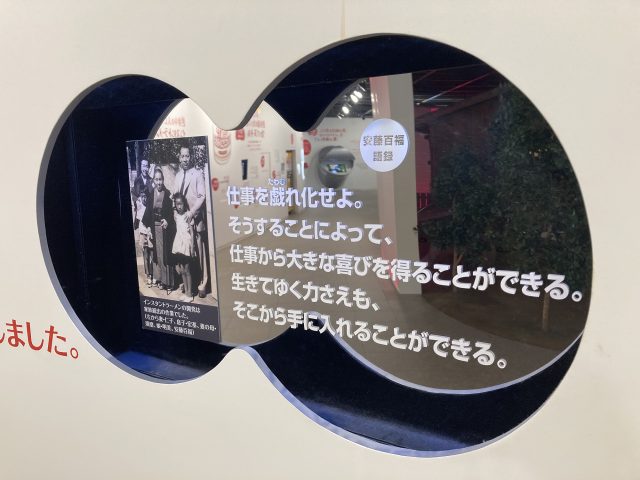
Words featured in Momofuku Ando and the Story of Instant Noodles (Photo courtesy of Nissin Foods Holdings)
Designed to pass on the venturing spirit
One notable exhibit is the work shed where Chicken Ramen, one of the museum’s concepts, was born. This replica is a faithful recreation of the modest work shed and is a symbol of how instant noodles originated and how they were developed. It conveys a strong message that having the passion and persistence to materialize your ideas is far more important than having sophisticated tools or plenty of money.
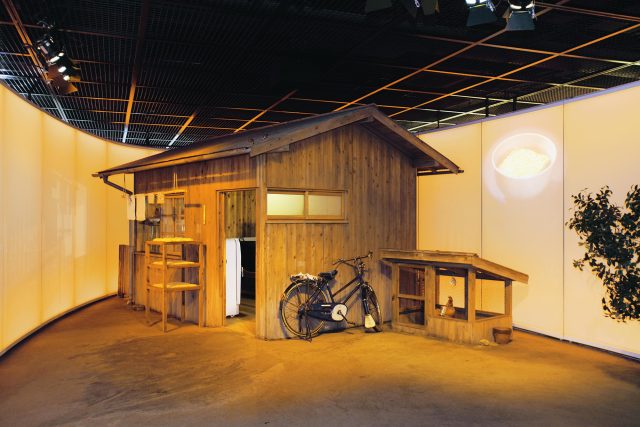
The research shed where Chicken Ramen, the world’s first instant noodles, was created (Photo courtesy of Nissin Foods Holdings)
To recreate the shed that had once belonged to Momofuku Ando, a rough sketch was compiled, with a discerning eye to include the cooking equipment, water faucets, and other objects used in Ikeda then. Residents were invited to the shed before its full-scale opening, and many reminisced about the period, some saying they had tasted the prototype Chicken Ramen.
The Chicken Ramen Factory is also a must-visit attraction. Visitors can learn about the origins of the development and philosophy behind Chicken Ramen at the work shed and enjoy and experience the invention process at the Chicken Ramen Factory.
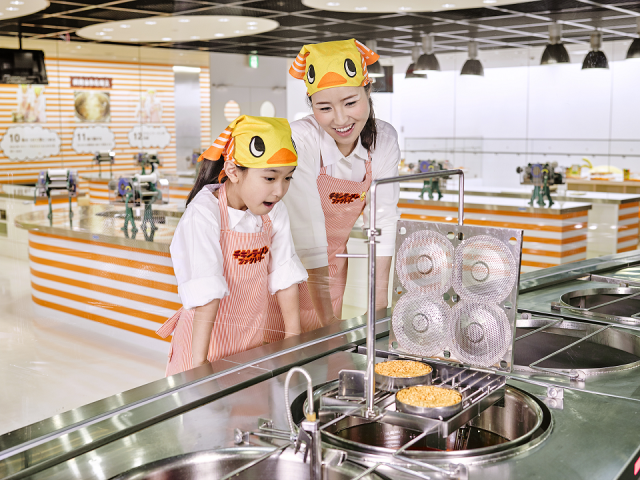
Visitors can make their own Chicken Ramen at the Chicken Ramen Factory (Photo courtesy of Nissin Foods Holdings)
The Chicken Ramen Factory was launched after months of simulation and repeated trial and error to determine the type of process and time allocation that would allow children to enjoy making the product. Particular attention went into quality and safety, and many test items were created to achieve the same level of quality as commercial noodles products.
Although the museum aims to offer an enjoyable experience to its visitors, there is more to this venue than simply showcasing products. It’s also about exploring the founder’s creative thinking and entrepreneurial spirit that led to the creation of Nissin Foods’ instant noodles.
Passing down the legacy and building a fanbase for generations to come
What is the role and significance of the corporate museum to the Nissin Foods Group? We spoke with Katsuhiko Kiyofuji, Director of the Cupnoodles Museum.
“Our top priority is to provide children, who will shape the future, with the opportunity to explore the wonders of innovation and exploration. Internally speaking, an important aspect of the museum is that it acts as a platform for passing down the founder’s ideas to future generations. Many people say this venue provides a formative experience for children and encountering something new can leave a lasting impression on their minds. If someone’s initial experience with instant noodles is with Chicken Ramen or Cup Noodles, they will likely develop a long-lasting affinity for the brand.
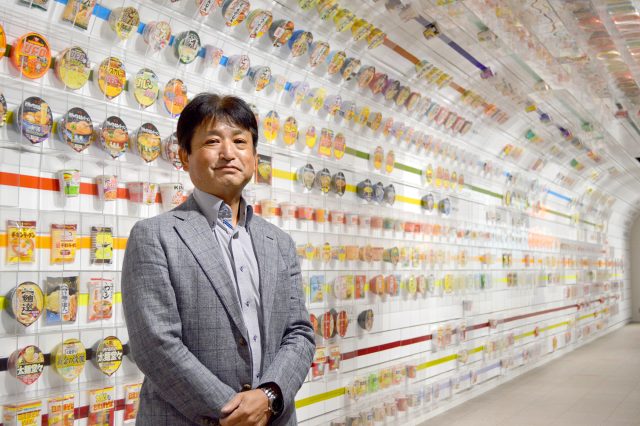
Katsuhiko Kiyofuji, Director of Cupnoodles Museum (Photo taken by the writer)
Experiences etched into their memories will remain with them through adulthood. And 10 or 20 years later, they will come to the museum with their children, creating fans of Nissin Foods across generations This is the goal the museum aims to achieve through building a medium- to long-term fan-building cycle. Mr. Kiyofuji says it is also an avenue to convey a sense of security and boost understanding of the instant noodle industry and food products. “Besides offering social learning by having people see the instant noodle manufacturing process, we will have them understand the structure and fundamentals of the industry and learn about the ingredients and other products, which will lead to a better understanding of safety.”
A destination where individuals can visit the core philosophies of the founder
The museum serves dual purposes – disseminating information within and outside the organization and facilitating internal communication by conveying messages to Nissin staff.
“The Nissin Foods Group values its founding spirit, which is not simply an old story from the distant past. It is an ongoing course of action that unites our employees to drive further growth for the company,” Mr. Kiyofuji explained. “The founder’s legacy lives on through our ongoing commitment to providing the world with the same joy and offerings he envisioned when he first started the company.”
Lately, there has been a growing emphasis on Purpose Management and the clarity of a company’s reason for existence. The Nissin Foods Group has been at the forefront of this trend, pioneering a system that upholds the spirit of Momofuku Ando, which has greatly increased employee engagement and has remained unbroken since its creation.
For example, staff may sometimes interact with visitors as part of their employee training program. By explaining the development process, the founder’s thoughts, and what instant noodles is to the visitors, they deepen their understanding of the brand and the founding spirit. When there are many staff members, they are divided between Osaka Ikeda, and Yokohama. And with the increasing number of mid-career hires in recent years, the museum is a training ground for individuals yet to visit the venue. These individuals are trained to uphold the museum’s founding philosophy.
Other unique initiatives are also underway at the museum. One example was during Chicken Ramen’s 60th anniversary when all employees visited Osaka Ikeda and Yokohama and made their own Chicken Ramen, and another when an original backgammon game was made for employees to learn the founder’s words. “Building it had been a big investment, but the museum serves as a crucial site, not only for external parties but for our employees to learn about our founding spirit,” Mr. Kiyofuji said.
A valuable tourist resource for Ikeda City
The Cupnoodles Museum Osaka Ikeda is an important tourism resource for Ikeda. Its use as a stamp rally venue for a tour held around Ikeda, and the appointment of Hiyoko-chan (Chickadee) as the first corporate character to serve as a tourism ambassador, are just a few examples of its initiatives.
Ikeda City also promotes community revitalization through Chicken Ramen and has launched a project called Osaka Ikeda Chicki Chicki Tankentai (Chicken Explorers), an initiative suggested by a group of local restaurant owners, not Nissin Foods, who called for interested parties to come up with creative menus using Chicken Ramen. Today, various creative dishes are offered at around 50 restaurants throughout the city, mainly in front of Ikeda and Ishibashi Handai-mae stations on the Hankyu Railway Takarazuka Line.
The museum is often included as a tourist site for tours of Osaka and the surrounding areas. For this reason, many visitors come from abroad. In the year when the number of visitors exceeded a million, 15 to 20 percent were from overseas. The museum has been using an app to support visitors in recent years, offering audio guidance in Korean, Chinese, and English.
After visiting the museum
The reason for a company’s existence resides in its founding spirit. As Mr. Kiyofuji says, the founder’s spirit is not a story from the past but an ongoing guideline for action that employees should always strive for. Precisely how to carry on that spirit so it does not fade will differ from company to company.
Having visited the museum, I could sense Momofuku Ando’s passion from every detail of the venue. This is not simply because of his great inventions but also because his entrepreneurial spirit of never giving up on anything continues to be respected by visitors, employees, and the local community.


