


The future of corporate museums as a PR asset #13 Kuronekoyamato History Museum
 2023.07.19
 2026.05.23
Corporate museums are part academic and business and occupy the grey zone in between. It is an organization that works with several departments in a company, including public relations, branding, advertising, and HR. This series aims to look at the role, function, and future of corporation-run museums through interviews with PR professionals.
“Open, not hidden” – The Integrity of the Kuronekoyamato History Museum
A company more or less tends to have a history that needs reflection on what is called a “dark past.” Yamato Group’s Kuronekoyamato History Museum, established by Yamato Holdings to commemorate the 100th anniversary of its founding, is just that type of museum: It does not hide that history but opens it to the public honestly and fairly. This article introduces Kuronekoyamato History Museum’s humble stance on learning from its history, including its internal and external mishaps. Let us consider how it is used for internal branding and fan building.

Interview and text: Hiromi Tateno, PR Consulting Dentsu Inc.
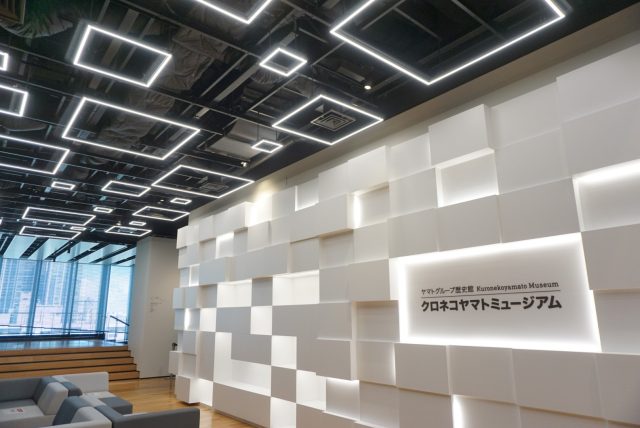
View of the entrance, with a square motif representing boxes of packages (Photo taken by the writer)
Established to commemorate the 100th anniversary of the company’s founding
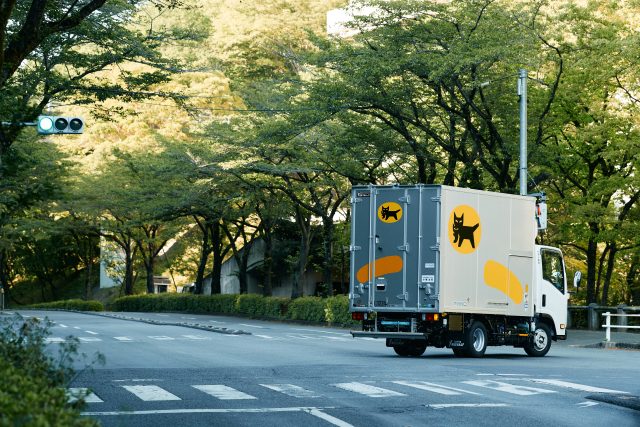
What comes to mind when you hear the name Yamato Transport? You have probably seen the distinctive trucks on the streets and the green uniforms with yellow accents standing out prominently. The word TA-Q-BIN, which has become familiar among the general public, is a registered trademark. And then there is Kuroneko (black cat). One can easily guess what it stands for. That is how well Yamato Transport has become a part of many people’s daily lives. However, the road was not smooth, and the Kuronekoyamato History Museum is a place that offers a look at the history of this Yamato Group.
The Kuronekoyamato History Museum was established in Minato-ku, Tokyo, a ten-minute walk from Shinagawa Station, to commemorate the 100th anniversary of the Yamato Group on November 29, 2019. With a total floor space of approximately 2,500 square meters, the museum exhibits more than 450 items and photographs, tracing the 100-year history of the Yamato Group, founded in 1919. A daily average of 200 visitors come to the museum on weekends and holidays (average for April to July 2022), and some 20,000 people have visited since it opened in July 2020 (as of July 31, 2022). Admission is free of charge.
An area built with the theme “to Connect “
The Yamato Konan Building, which houses the Kuronekoyamato History Museum, is a 10-story building with the Yamato Group offices and the Yamato Group Research Institute on floors seven through ten. The museum is on the sixth floor along the outer slope extending below. The first through fifth floors are TA-Q-BIN sales offices, serving as a collection and delivery base, and a route within the museum above and below the slope is a road for trucks, a contrivance unique to the Yamato Konan Building constructed as a place for interaction with customers under the theme of Tsunagu (to Connect).
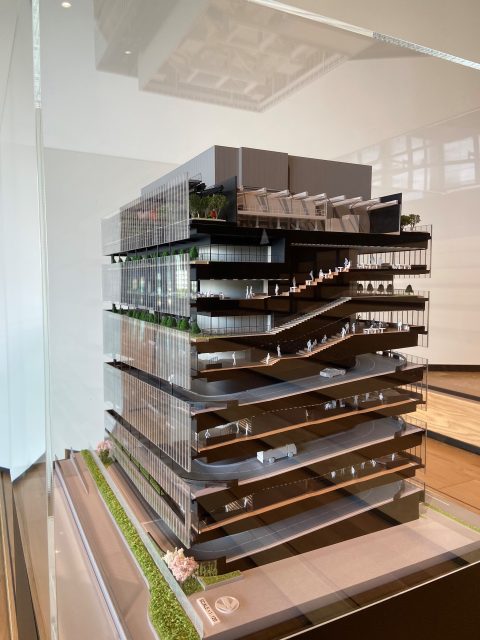
A cross-sectional model of the Yamato Konan Building (Photo taken by the writer)
The first display after passing through the museum entrance on the sixth floor is a circular theater with a large 14-meter-wide screen. An animated film is shown every 15 minutes, introducing the story about the Yamato Group and a certain family over the past century, helping visitors visualize the 100-year history of the Group. From there, the exhibit is divided into four major areas in line with the times: “1919 – The early years,” “1928 – The Era of YAMATO COURIER and Business Diversification,” “1971 – The Era of TA-Q-BIN,” and “2,000 – The Era of New Value Creation,” with visitors descending slopes from the sixth floor to approach the present day gradually.
Uniforms displayed to convey the philosophy of the company’s founding
The first area, “1919 – The early days,” exhibits items on the Yamato Group at its beginning and the changes in Ginza, where it was established. The founder, Yasuomi Ogura, purchased four trucks, which were still expensive when Japan was transitioning from ox- and horse-drawn carts to automobiles, and founded Yamato Transport Co., Japan’s first freight forwarding company. Through repeated trial and error, the company grew to solidify its business foundation within about four years from its founding by signing a contract with Mitsukoshi Gofukuten (Mitsukoshi today) to deliver merchandise. The company later succeeded in new businesses such as moving and wedding furniture transportation services.
This area displays a replica of the uniform and hats worn at the time of the company’s founding. Although unusual at the time, it was adopted with the belief that drivers were the face of the company in the transportation industry. It continues to be a symbol of trust and dignity today, and this exhibit conveys the philosophy that has continued since the company’s founding, leaving visitors with a lasting impression.
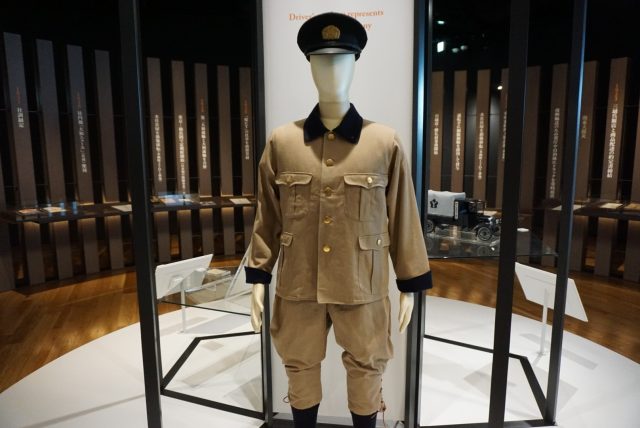
Replica of the uniform and hats from the time of the company’s founding (Photo taken by the writer)
According to Miki Shiratori, director of the Kuronekoyamato History Museum, its conveyance of the founding principles of the Yamato Group functions as internal branding because the building houses the Yamato Group facilities. “Many of our employees who have visited the museum have said that by looking back at our history, they have been able to reconfirm the philosophy and other aspects of our company, and I think it contributes to a greater sense of belonging,” she said.
Birth of the Kuroneko (Black Cat) logo

The second area of the museum is “1928 – The Era of YAMATO COURIER and Business Diversification.” Here, the company’s history is presented from the full-fledged start of the YAMATO-BIN (Yamato Courier), said to be Japan’s first regular route transport service, up to the launch of the TA-Q-BIN business in 1971.
In 1927, Yasuomi Ogura noted a delivery system in London during an inspection tour, brought it back, and launched it in Japan. Instead of the conventional chartered transportation system where a particular consignor’s cargo was kept in one car, this system combined loads of multiple consignors onto the same vehicle. The network was expanded to the Kanto area in 1935, and the company took on duties related to the GHQ and continued to grow after the war. It later advanced into new businesses, such as the transport and packing of art and railroad freight forwarding, giving birth to many businesses that have continued to the present day.
Another symbolic item that came to be during this era was the familiar Kuroneko, or black cat logo, which represents the careful handling of packages in the same way that a mother cat would carry its kitten. The exhibition area offers an introduction to the story behind the development of the cat logo, inspired by a picture drawn by the daughter of a company employee.
The cat logo was redesigned for the first time on April 1, 2021, along with a new Advance Mark to symbolize the challenges the company is taking on to provide unique value.
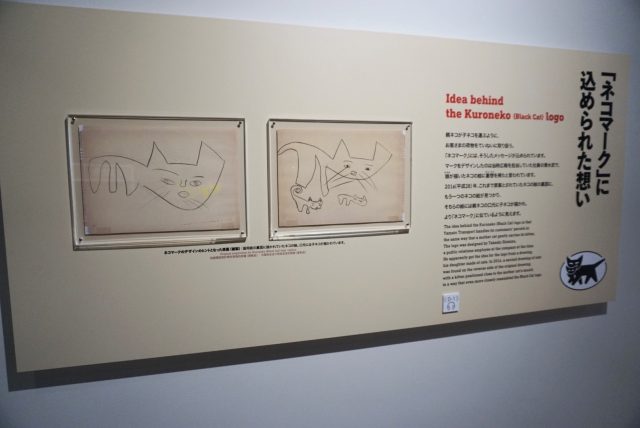
A display shows the thoughts behind the Kuroneko logo (Photo taken by the writer)
Why the dark history of the company is also displayed
The 1960s, the last part of this section, was a rock-bottom period for Yamato Transport. It had diversified its business, been at the forefront of the industry, but stuck to its successful sales area in the Kanto region. Thus, it used Japan National Railway’s high-speed freight trains instead of trucks for long-distance transportation. When expressways were built, vehicle performance improved, long-distance transport shifted from rail to trucks, and consignors used pioneer businesses, leaving Yamato Transport lagging in market entry. As a result, Yamato Transport was mentioned in a book, “Abunai Kaisha (Risky Companies),” written by economist and Kobe University Professor Kuniyoshi Urabe, as a company that used an old system and fell into a business crisis.
As if to express that rock-bottom period, the atmosphere of the exhibition area for this period differs slightly from the previous displays. The walls are painted black, and hanging from the ceiling are negative words such as “risky company” and “clearly behind.”
Ms. Shiratori says this is an intentional expression of the dark clouds cast over Yamato Transport at the time. “While we put up glamorous items on the walls to represent the various periods, instead of setting up these things concerning Yamato Transport on the walls, we made them tumble down to the floor to show that dark clouds were hanging over the company during this era.”
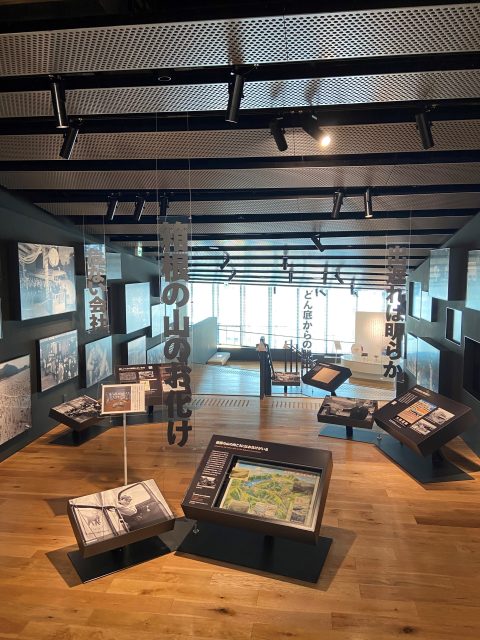
Display for the 1960s, a rock-bottom period for the company (Photo taken by the writer)
The third area, “1971 – The Era of TA-Q-BIN,” was when Masao Ogura became the second-generation president and replaced Yasuomi Ogura, who was undergoing medical care. Entrusted with rebuilding the company, Masao Ogura noted the absence of an easy way to send packages door-to-door and decided to focus on the individual business category. However, management strongly opposed to his decision, and that confrontation was rendered as another eye-catching display that is easy for visitors to see what was going on.
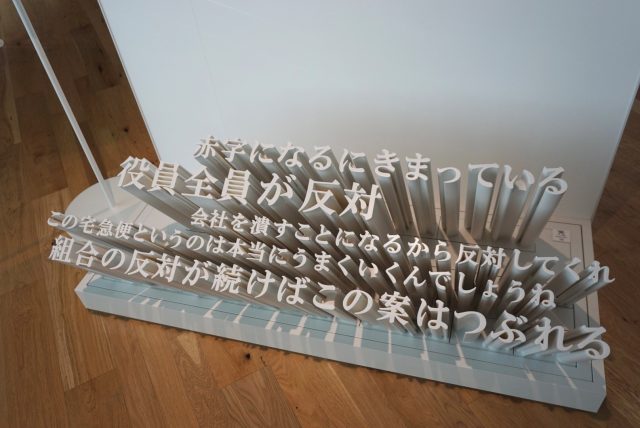
TA-Q-BIN was initially met with tremendous disapproval from management (Photo taken by the writer)
Why go to the trouble of displaying something negative for the company in its corporate museum? Again, what is important here is internal branding. While some exhibits, such as in the first area, are designed to boost a sense of belonging among employees, others, as in this area, are designed to raise awareness so that the same mistakes are not repeated and to foster a mindset of challenge in creating innovation.
“It was a negative time, but it was also a time when one of our innovations was born, so we couldn’t consider leaving it out,” Ms. Shiratori said. TA-Q-BIN, which started when the labor union finally showed its understanding, began serving rice shops and other stores as agencies and expanded its business base. With the birth of Cool TA-Q-BIN and other services, it could transport more items, gain significant support, and spread as a transport service that many people would use.
Further ahead is the TA-Q-BIN Hands-on corner, where visitors can try on a sales driver’s uniform, have their photo taken, and experience loading packages. Particularly impressive is the display of a walk-through vehicle that had actually been in use. Visitors can ride inside the vehicle, see what it looks like, and experience how it was designed to transport packages safely. The exhibit is very popular with children and contributes to attracting future fans, and is clearly designed to target visitors, including various stakeholders. According to Ms. Shiratori, visits by elementary school pupils on field trips and university students are also increasing.
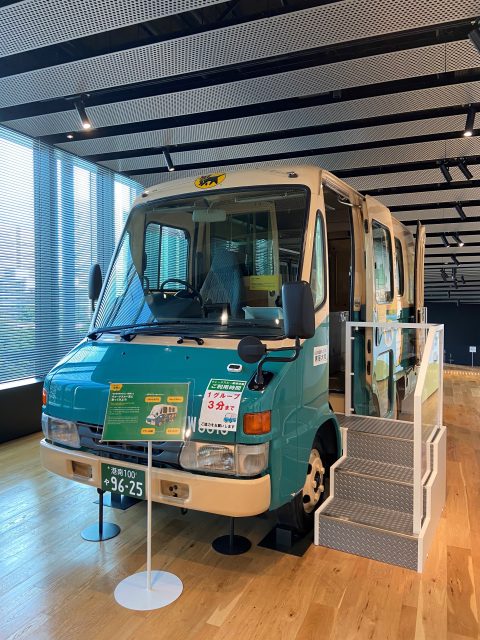
A walk-through vehicle for visitors to experience (Photo taken by the writer)
A device for thinking about the future with visitors
The last area is “2,000 – The Era of New Value Creation.” It exhibits new forms of logistics that meet diversifying needs, such as the PUDO Stations, open-type parcel delivery lockers that have been rapidly increasing in numbers in recent years. There is also a Future Creation Lounge, where visitors can imagine and draw pictures of their future lifestyles. This exhibit should indicate the future of the Yamato Group, which aims to be a creator of transportation rather than a transportation company, and also serve as a device for stakeholders and visitors to see the future the Yamato Group creates from a personal perspective.
Internal branding propagates
The museum ends with a walk through the 100-year history of the Yamato Group. The exhibits and display methods gave me the impression that this was a corporate museum built with internal branding in mind.
“When I thought about the type of legacy I wanted to leave behind for our 100th anniversary, the first thing that came to mind was employee training. I think there are many things that we can learn from history. We began creating this museum to have our employees see that part of our history,” Ms. Shiratori said.
What is also interesting about the museum is that open internal branding is also propagated to stakeholders and the general public, contributing to creating fans outside the company. The museum has received many positive comments in visitor questionnaires, saying visitors have become greater fans of Yamato and would like to continue to use its services. Perhaps the sincerity in designing the museum, including its rock-bottom periods, has created many fans, myself included.