


 Insight TOP
The future of corporate museums as a PR asset #12 Shimadzu Foundation Memorial Museum
Insight TOP
The future of corporate museums as a PR asset #12 Shimadzu Foundation Memorial Museum

The future of corporate museums as a PR asset #12 Shimadzu Foundation Memorial Museum
 2023.07.18
 2026.05.23
Corporate museums are part academic and business and occupy the grey zone in between. It is an organization that works with several departments in a company including public relations, branding, advertising, and HR. This series aims to look at the role, function, and future of museums run by corporations through interviews with PR professionals.
The Shimadzu Foundation Memorial Museum— the origin of Japan’s modern science
The Shimadzu Foundation Memorial Museum in Kyoto, Shimadzu Corporation’s birthplace, was opened in 1975 to commemorate the 100th anniversary of the company’s founding, and it is a pioneer among corporate museums. Many representatives of famous companies visit seeking the expertise of the museum’s management. It quickly garnered attention from all over the world when Koichi Tanaka, a researcher from Shimadzu Corporation, received a Nobel Prize in 2002. Here, we explore the area where that event originated and see how a BtoB business without many points of contact with consumers creates fans.

Rena Okauchi, PR Consulting Dentsu Inc.
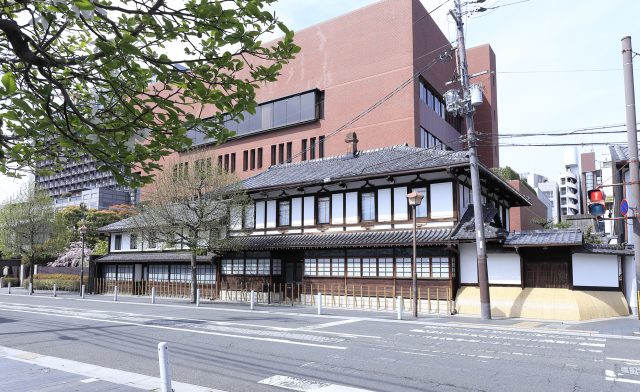
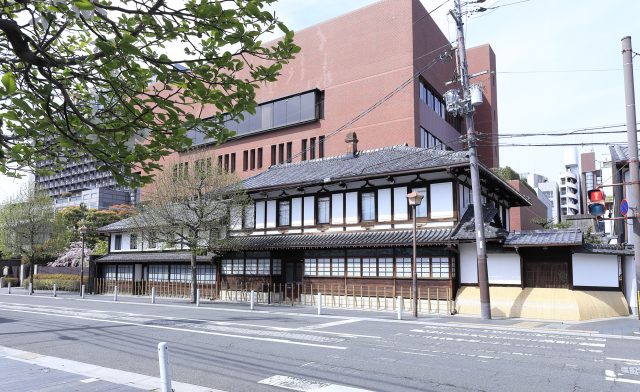
Exterior of Shimadzu Foundation Memorial Museum (Photo courtesy of Shimadzu Corporation)
From the exit of Kyoto Shiyakusho-mae Station, head toward the Kamo River, and walk in the direction opposite the current of the adjacent Takase River. Near its source, you will see a wooden two-story townhouse building with a pantile roof. That is the Shimadzu Foundation Memorial Museum, the subject of this story. The building, its colors still as vivid as at the time of its founding, was designated as a Registered Tangible Cultural Property by the national government in 1999 and a Heritage of Industrial Modernization by the Ministry of Economy, Technology and Industry in 2007. Its touches of Western and Japanese architecture, such as its Western-style windows and stained glass, are popular according to visitor surveys and tourism sites.
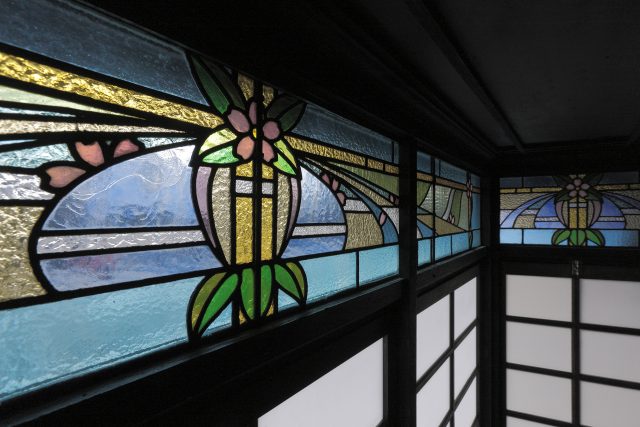
Stained glass designed with characters for Japan (Photo courtesy of Shimadzu Corporation)
The founder, Genzo Shimadzu Sr., and his first son, Genzo Shimadzu Jr. (who was called Umejiro as a child and took the name Genzo Shimadzu Jr. after his father’s death), used the building as their headquarters and home. To commemorate the 100th anniversary of the company’s founding, it was reborn as the Shimadzu Foundation Memorial Museum in 1975. The museum contains about 11,000 pieces of historical documents and artifacts including physics and chemistry instruments that the company manufactured and sold, medical X-ray systems, and industrial machinery created since the company’s founding.
According to Misako Kawakatsu, Deputy Director of the Shimadzu Foundation Memorial Museum, ordinary visitors from Japan and abroad increased after Koichi Tanaka (an executive research fellow at the time) received the Nobel Prize in Chemistry in 2002. After it was later renovated, it exhibited not only the history of Shimadzu Corporation, but also the history of Kyoto’s modernization and Japan’s industries. The museum has also gained more visitors over the years since it garnered attention as a Heritage of Industrial Modernization. Before the COVID-19 pandemic, it saw an average of about 16,000 visitors per year.
The area carries on the spirits of the founder
Shimadzu Corporation is a global company that develops businesses in a wide variety of areas with a focus on analytical and measuring instruments, medical equipment, industrial machinery, and aviation equipment. 147 years ago, Genzo Shimadzu Sr., a craftsman of Buddhist altar fittings, founded the company and began manufacturing physics and chemistry instruments with the belief that resource-poor Japan must become a country founded on science.
Genzo Shimadzu Sr. not only dealt in manufacturing equipment, but he also published scientific journals, held lectures to educate and raise awareness about science, and built relationships with many people. He devoted himself to education and development in science and technology. Later, his first son, Genzo Shimadzu Jr., took on his dying wishes and began developing X-ray machines, storage batteries, and other innovations. Genzo Shimadzu Jr. greatly contributed to the development of science and industrial technology, earning him the title of one of Japan’s ten greatest inventors in 1930 and the nickname of Japan’s Edison.
The museum was established by the president at the time, who sensed the danger of losing all of the employees who worked with Genzo Shimadzu Jr. and wanted to pass the spirits and historical artifacts of the two Genzos onto the next generation of employees. Furthermore, the spirit of the founders is carried on to this day in the form of the company’s corporate philosophy, “Contributing to Society through Science and Technology,” and its management principle, “Realizing Our Wishes for the Well-being of Mankind and the Earth.”
Exhibits designed to be enjoyed from open perspectives
When you step into the entrance, you are greeted by a gentle, pleasant scent. Incense is burned in a show of hospitality to help visitors relax.
Standing prominently at an entrance exhibit with the title, “Welcome to the Land of Our Founding” is the DIANA medical X-ray system first sold in 1918. In 1896, the year after X-rays were discovered by the scientist Röntgen, Genzo Shimadzu Jr. worked with professors from the Third Higher School (now Kyoto University) and others to successfully make X-ray images, and in 1909, they developed the first medical X-ray system produced in Japan. In a time when most X-ray systems were imported, DIANA was first used by individual hospitals and contributed to the rise of domestically produced X-ray systems. It is an exhibit representative of medical equipment from the beginning of Japan’s modernization.
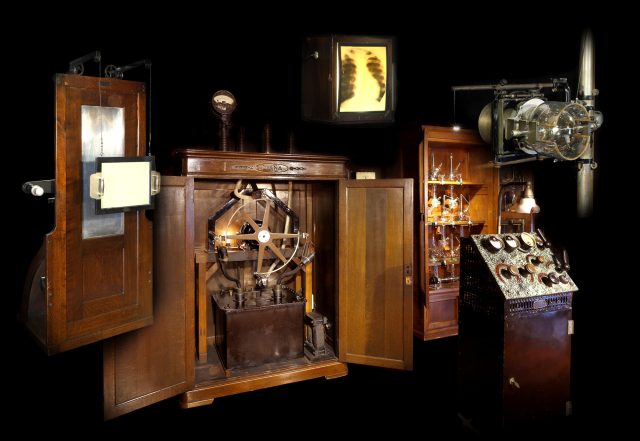
DIANA medical X-ray system (Photo courtesy of Shimadzu Corporation)
Another noteworthy exhibit is a collection of warnings titled by Genzo Shimadzu Jr., “People who Interfere with Business.” These 15 warnings based on the founder’s own experiences and struggles give an idea of his personality and his strictness toward others and himself. Among them are “People who execute anything with no planning,” “People who put off work until tomorrow,” and others that people can still relate to today, 80 years later. Visitors often stop to read them.

Warnings, “People who Interfere with Business” (Photo courtesy of Shimadzu Corporation)
The second floor area exhibits physics and chemistry instruments, mineral samples, industrial machinery, and other items from the history of Shimadzu Corporations businesses. Deputy Director Kawakatsu says about the exhibit’s design, “These instruments are the results of Shimadzu Corporation’s scientific thinking, and we are devoted to exhibiting them so that visitors gain interest from the perspective of the history of education in science and from a artistic perspective.”
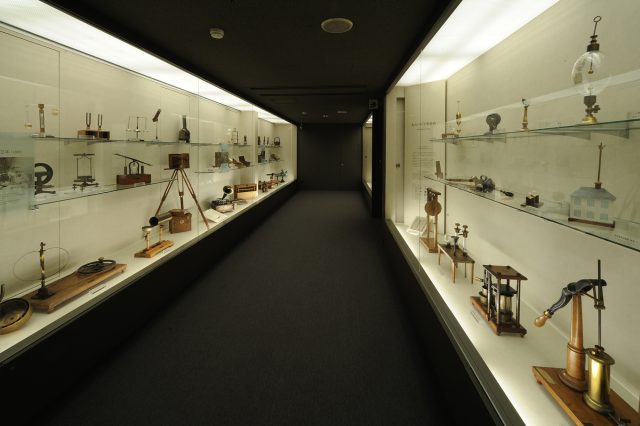
Exhibit with physics and chemistry instruments and other items (Photo courtesy of Shimadzu Corporation)
Physics and chemistry instruments are lined up like artwork and antiques. It is worth noting that the caption for each item has only its name, without a detailed explanation. The explanations in the exhibit are kept extremely simple so that visitors do not get the idea that complicated products equal an aloof company. The exhibit is designed so that visitors can view it freely from their own perspectives. This way, they will not feel that the items are complicated, but will look up products they are interested in on their smartphones, see their elegance, and enjoy them in other ways.
The exhibit that best displays the talent of Genzo Shimadzu Jr. is Japan’s first Wimshurst electrostatic generator, a machine that generates high voltages through electrostatic induction, from a single illustration that he made in 1884 at just 15 years old. It was later used to power X-ray imaging systems and led Shimadzu Corporation to expand into various businesses.
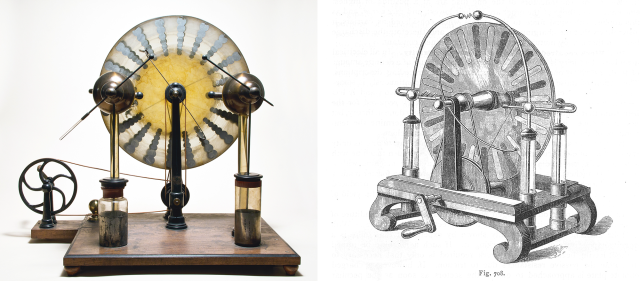
Wimshurst electrostatic generator (left) and illustration used as reference by Genzo Shimadzu Jr. (right) (Photo courtesy of Shimadzu Corporation)
The origin of Kyoto’s mannequin manufacturing
One thing that is particularly surprising is that Shimadzu Corporation once had a sample department that manufactured mannequins. The sample department was created in 1895 and worked in making artificial plants, mineral samples, and anatomical models. When demand increased for Western clothes, the company began using its anatomical model manufacturing technology to produce its own mannequins. Combining sophisticated artistic sense and advanced technology, Shimadzu’s mannequins occupied over 85% of the domestic market at their peak. Although mannequin manufacturing has been passed on to other companies, Shimadzu Corporation was the origin of Kyoto’s many mannequin manufacturers.
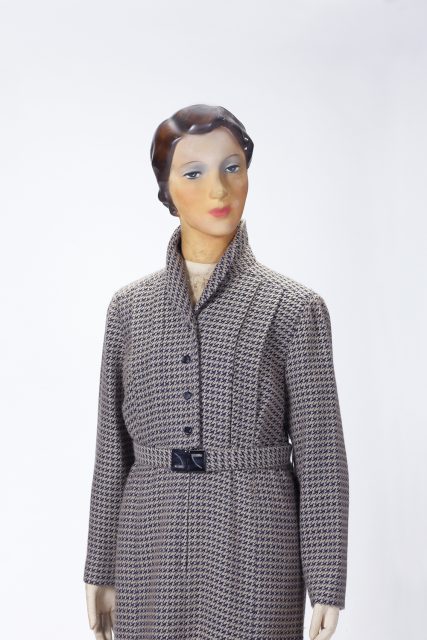
Shimadzu mannequin (Photo courtesy of Shimadzu Corporation)
Scientific progress seen through products and pamphlets
The final exhibit room features a wall covered in analysis and measuring instruments, which are the company’s major products today, along with other products and many pamphlets from the time they were released. These provide a view of the history of the development of products that were a result of Japan’s modern industrialization. Some visitors have conversations saying things such as, “We once used these products for research. Those were the days.”
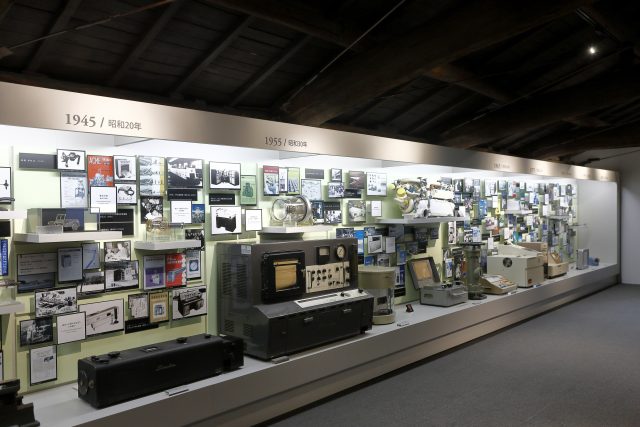
Exhibit teaching the history of the development of products that were a result of Japan’s modern industrialization (Photo courtesy of Shimadzu Corporation)
The experiment corner that adults and children can be absorbed in
There is also an experiment corner that is popular among children and adults alike, where they can experience the mysteries of science. The experiments here teach the principles of collisions and how movies are made, expressing the spirits of Genzo Sr. and Jr. and embodying the importance of thinking of things from a scientific perspective. Children who visit can also have fun, with worksheets prepared for early and late elementary school students, and they can receive presents for getting correct answers. Many families bring their children during summer and winter break.
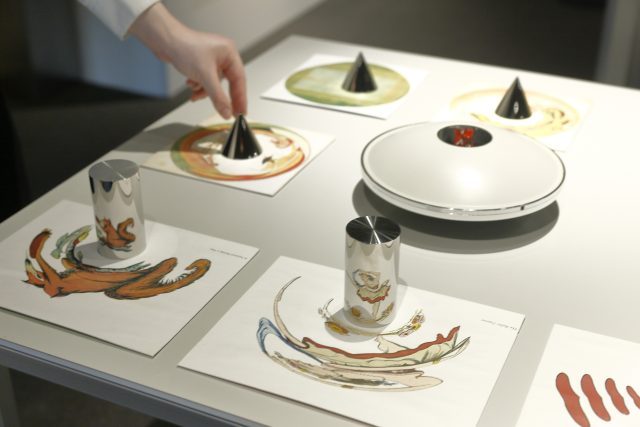
Experiment corner (Photo courtesy of Shimadzu Corporation)
A base for creating fans
What is the Shimadzu Foundation Memorial Museum to the company? We asked Chikako Kojima of Shimadzu Corporation’s Corporate Communication Department’s PR group. “Sixty percent of our visitors are customers or business partners, and even though they know about Shimadzu Corporation’s products and initiatives, they don’t know about our foundation. Also, Shimadzu Corporation’s products are not used at home, so ordinary guests don’t get to experience them at home. At our museum, instead of hearing complicated lectures about technology, they learn about our history of contributing to society and relate to Shimadzu Corporation’s stance. I am thankful for that.”
Regarding the impressions of their visitors every day, Deputy Director Kawakatsu says, “I can feel the distance between guests and the company close whenever they learn the history of Shimadzu Corporation and become interested.” Even among the locals in Kyoto, there are many people who have heard Shimadzu Corporation’s name but do not know what the company actually does.
DNA carried overseas and into the future
Shimadzu Corporation also has many bases abroad. In order to communicate the spirits of the founders to the employees in each area, the museum holds online tours with overseas bases and cooperates with facilities that collect physics and chemistry instruments overseas to conduct research and hold exhibits. These activities help increase the motivation of employees in other areas, with feedback such as, “I was inspired by information on the creations by Genzo Sr. and Jr.,” and “I want to visit the museum in person.”
In order to foster the next generation of scientific minds, the museum also holds workshops for elementary, middle, and high school students that use old physics and chemistry instruments. Through these activities and the publication of scientific journals and catalogs of physics and chemistry instruments, the thoughts of Genzo Sr., who was devoted to education in science and technology, are passed on.
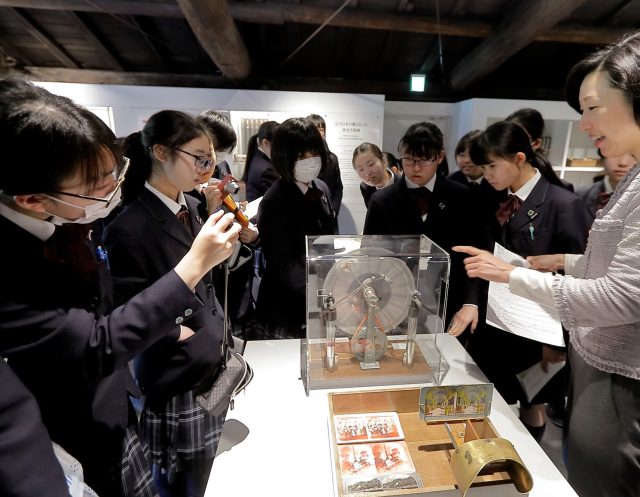
Workshop for high school students (Photo courtesy of Shimadzu Corporation)
In conclusion
Standing in the museum’s entrance is a bust of the founder Genzo Sr. with an old Chinese saying inscribed in it wishing that although it has been long since its founding, the business will stretch like the flow of a river. By visiting the museum, we got up close with Shimadzu Corporation’s many products and their stories at the company’s birthplace, and we could definitely feel it stretching.
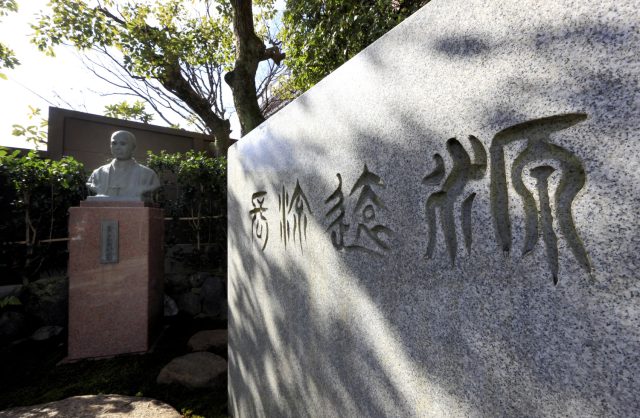
Bust of Genzo Sr. and inscription of old Chinese saying (Photo courtesy of Shimadzu Corporation)


