



The future of corporate museums as a PR asset #08 Panasonic Museum
 2023.06.19
 2026.05.23
Corporate museums are part academic and business and occupy the grey zone in between. It is an organization that works with several departments in a company including public relations, branding, advertising, and HR. This series aims to look at the role, function, and future of museums run by corporations through interviews with PR professionals.
From his perspective on management to life, you can learn more about the “God of Management” at this museum
At the Panasonic Museum in Kadoma City, Osaka Prefecture, visitors can follow the life of the “God of Management” himself, Konosuke Matsushita. Konosuke saw management as an expedition worth taking, and it’s his spirit, the man who was at the helm, that can still be felt in this museum. In this article, we’ll look at how the Panasonic Museum can tell us more about Konosuke’s approach to corporate management and his philosophy on life.
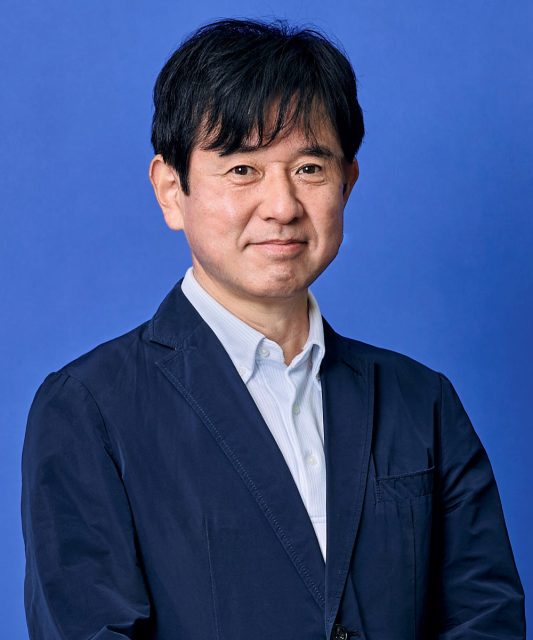
Koki Aihara, PR Consulting Dentsu Inc.
A place of learning for everyone
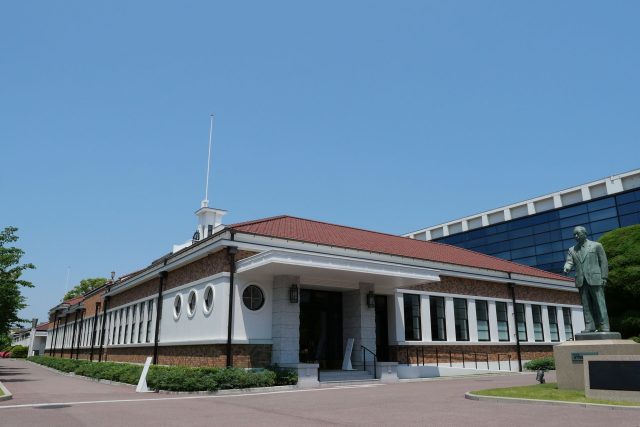
The Panasonic Museum is just a short walk away from Nishisanso Station, which is a 20-minute train ride on the Keihan Line from Yodoyabashi Station in the center of Osaka. The Panasonic Museum reopened after renovations on March 7, 2018 to commemorate the 100th anniversary of the founding of Panasonic (formerly Matsushita Electric Industrial Co., Ltd.). The museum was renovated from the Matsushita Electric Industrial House of History), which opened on the 50th anniversary of the company in 1968. Admission is free for all visitors, as Panasonic wanted the museum to be a place of learning for everyone. It is a place where, through the words of its founder, Konosuke Matsushita, and products from the past, the spirit and passion of Panasonic could be shared with many for generations to come. The museum consists of the Konosuke Matsushita Museum, where you can get an insight into how Konosuke viewed management and life, the Hall of Manufacturing Ingenuity, where you can learn more about the roots of manufacturing, and Sakura Hiroba, a garden where people from the city can relax.
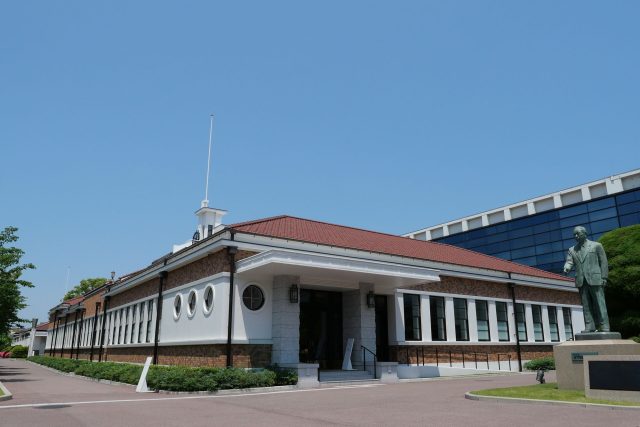
The statue of Konosuke Matsushita in front of the Panasonic Museum. (Photo courtesy of Panasonic Holdings)
The Konosuke Matsushita Museum, the closest building to the station, is located on the exact spot where the third head office of Matsushita Electric, completed in 1933, was located. The building is a symbol of this museum and is a faithful reproduction of the appearance of the third head office at that time. When you enter the museum, the first thing you’ll see is a panel of “The Way,” written by Matsushita himself. The words of Konosuke give guests a warm greeting.
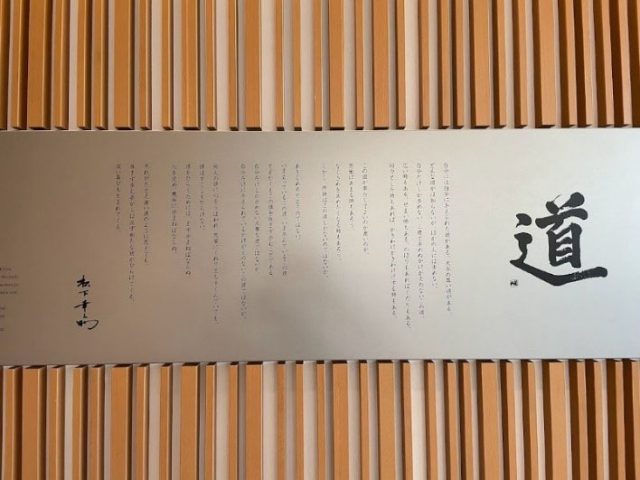
The panel of “The Way” attached to the entrance wall. (Photo by the writer)
In addition to “The Way,” the words of Konosuke remain in important places in the exhibition room. You are free to take the cards home with you, with words on them such as “Making people before products” and “Keep on trying until you succeed.” If you collect all the cards, it becomes a collection of thirty gems of wisdom.
The exhibition consists of seven chapters: Chapter 1, Cornerstone, Chapter 2, Foundation, Chapter 3, Mission, Chapter 4, Quandary, Chapter 5, Quantum Leap, Chapter 6, Breakthrough, and Chapter 7, Quest. Panels, videos, and exhibits of actual products of the time are displayed tracing Konosuke’s 94-year life as “The Way.” It’s a facility where you can get a deep understanding of his views on his way of life and way of thinking that Konosuke developed while overcoming numerous challenges.
The house where Panasonic started, which recreates the workshop at the time of foundation, displays items like pots and pans, a step machine, and a pressing machine that were used back then. This is the workplace where manufacturing began 100 years ago. Now, we live in a time where not many people are working in factories due to automation. So, it’ll be interesting to think about the times when many people were working in the factory, and how they were moving their hands and feet every day, what they talked about, what they learned from their failures, how they made improvements, and how they developed their commitment as craftsmen.
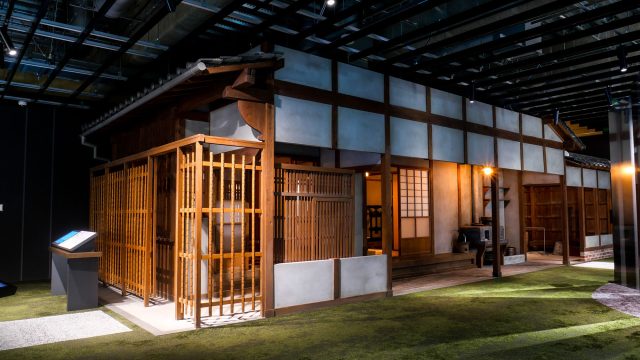
Recreation of the leased house at the time of foundation. (Photo courtesy of Panasonic Holdings)
Home appliances that have come to create lifestyle culture are on display
The adjacent building, the Hall of Manufacturing Ingenuity, displays approximately 550 home appliances that have created a new lifestyle culture since the foundation. These are the home appliances that were cutting-edge products, such as black and white TVs, washing machines, and refrigerators, known as “Three Luxury Appliances”, and audio equipment that dominated the world under the Technics Brand. Since I grew up with them, I find that they are very nostalgic.
The section with advertisements from the foundation to the 1980s also seems to have been well received by visitors. It’s a place of learning for students studying industrial design, and they were enthusiastically looking at the displays. It can be said that the museum functions as a facility that makes people experience the enthusiasm of the many predecessors who have poured their passion into manufacturing and their connection to the next 100 years. The guide pamphlets are distributed in Japanese, English, and Chinese, and the videos on display in the museum are also available in Japanese, English, and partly in Chinese.
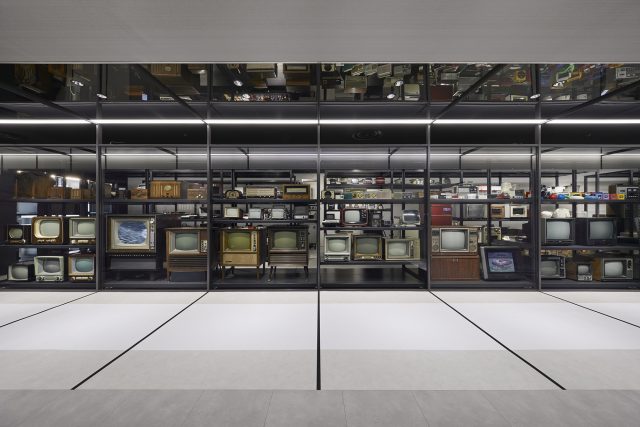
Storage displaying numerous products. (Photo courtesy of Panasonic Holdings)
Established as a place for employee education
Mr. Hisaya Takahama, Director of Panasonic Museum from the Corporate History Office at the time of this writing, kindly gave me a detailed explanation of the activities. Since the foundation in 1918, Konosuke Matsushita focused on human resource education, such as establishing the Employee Training Institute (1934) and the Matsushita Electric Employee Training Institute (1964). In 1968, the Matsushita Electric Industrial House of History, the predecessor of the current Panasonic Museum, opened as the 50th anniversary project. Its concepts are “Home of Our Heart” and “A Place of Self-Improvement” for all employees to understand the history of the company, to feel proud, to remember the achievements of their predecessors, and contribute to the development of the company business.
In 1976, a division called the Corporate History Office was established, which included the House of History under its scope. This was the original form of the History, Culture, and Communication Office. Today, the Corporate History Office has three roles: The preservation and management of materials related to the company history, the compilation of the company history, and the exploration on the business view of the founder and dissemination of the founder’s spirit both inside and outside the company. The purpose of the museum is employee education, which is inherited from the Matsushita Electric Industrial House of History.
Contributing to the local community, society, and business
In addition to employee education, the museum is also responsible for contributions to the local community and society, and business contributions. As a corporate citizen, the company seeks to create fans of Panasonic through exhibitions, workshops, and create lively events that are highly unique as a place open to the local community and society. The museum is often used for school trips and other extracurricular activities. As for business contributions, the company is fostering a sense of trust by welcoming business partners from Japan and overseas. It’s said that about a quarter of the total is from overseas (before COVID-19).
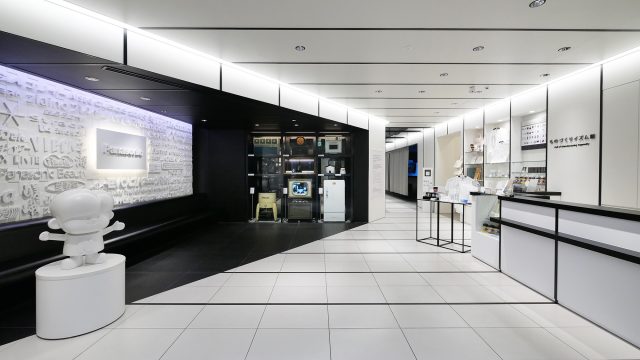
The entrance to the Hall of Manufacturing Ingenuity. It’s also the entrance to Konosuke’s philosophy. (Photo courtesy of Panasonic Holdings)
Due to COVID-19, the company is shifting to online information dissemination
When it opened, the museum actively conducted public relations activities both inside and outside the company and events linked to the local community. However, due to COVID-19, from the spring of 2020, the number of visitors went down from 270,000 a year to 50,000, and the environment changed drastically. As a countermeasure, the company strengthened the use of online services. The company is distributing programs with notable external people four times a year to target the next generation and distributing self-development contents six times a year based on books published by PHP Institute. In addition, employees themselves are sending live exhibitions. The total number of online page views in FY2021 reached approximately 1.6 million and the number of video views reached 930,000. The company actively utilizes social media, such as Facebook and Instagram, to actively spread information and grow their followers.
Strengthening internal communications
Furthermore, starting in FY2021, the Panasonic Museum decided to focus on employee education, with employees as key stakeholders, or in other words, strengthen internal communications. This is due to a significant change in the group structure, with Panasonic becoming a holding company in April 2022. The idea behind this is that it’s important to return to the founder’s philosophy and create a strong Matsushita identity to accelerate the specialization of each operating company.
The current management policy was translated into multiple languages and delivered to the company’s employees around the world. There are only two facilities like the Panasonic Museum, in Japan and China, where we can learn about the history. In order to deepen our understanding of the Basic Business Philosophy, the museum provides digital content online that can replace the facilities. If employees don’t understand the philosophy of the company, they cannot communicate their activities to the world and contribute to the company. Panasonic is conveying its unique history that is focused on human resource education, and I think they’re doing it well.
Who is Konosuke Matsushita, the “God of Management”?
I’ll briefly explain who Konosuke Matsushita is. Many manufacturing companies are gathering in Kadoma City, Osaka Prefecture, and its surrounding cities. From the latter half of the Meiji period to the early Showa period, transportation routes were developed in this area and industrialization progressed. In particular, since the head office and factory of Matsushita Electric, founded by Konosuke Matsushita, moved to the city in 1933, the number of related factories has increased, and the city changed drastically as “The City of Manufacturing.”
Konosuke devoted himself to the world of electricity starting at the end of the Meiji period, when even electric lamps were not so common, and ended his life at the beginning of the Heisei period (1989), which was just before the era of IoT. We can say his life was a success story symbolizing the Showa period, the era of high economic growth in Japan. He started as an apprentice of a brazier shop in Osaka at the age of nine, overcoming numerous difficulties and continuing to walk his own “Way.” He had a charming personality with a strong spirit that pursues both the prosperity of society and the hearts of ordinary people. Konosuke, who had been successful as a manager, came to be called the “God of Management.” His way of life still moves the hearts of many people both in Japan and overseas.
Through his own efforts in management and ethics education and publishing activities at the PHP Institute, which was founded in 1946 immediately after the war, Konosuke confronted the fundamental question of “What is a human?” An astonishingly long-selling book, “The Path,” is a collection of short essays written by Konosuke based on his deep insight into his experiences and life. Since its first publication in 1968, more than 5.5 million copies have been sold. The book is sold at the museum shop with an exclusive original cover for 870 yen, excluding tax, along with many other PHP books.
At the shops in both museums, you can buy exclusive nostalgic National Boy (National was a brand name used by Panasonic in Japan and other parts of the world excluding the United States from 1927 to 2008) character goods, as well as original products and PHP books.
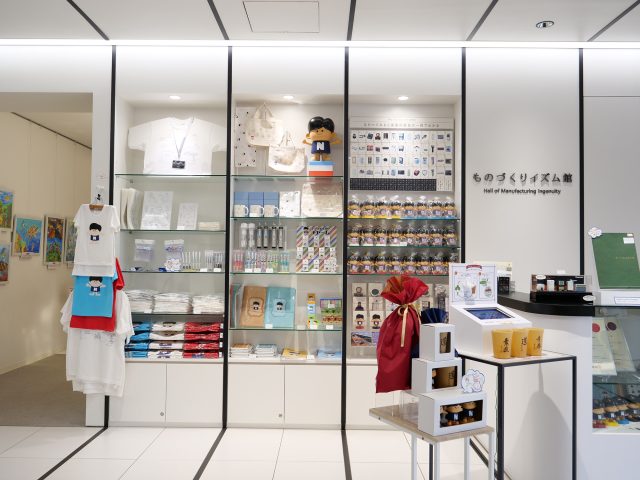
The museum shop inside the Hall of Manufacturing Ingenuity. (Photo courtesy of Panasonic Holdings)
The Sakura Hiroba, which is open to the citizens as a place of relaxation, is also very impressive. On the 16,200 square meter site, 190 Somei Yoshino cherry trees are in full bloom in spring.
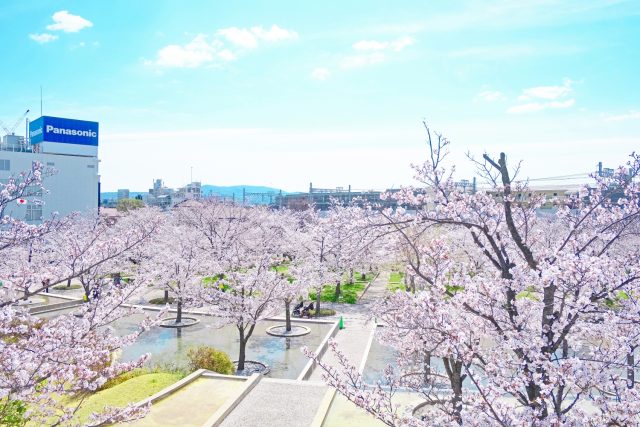
Sakura Hiroba (Photo courtesy of Panasonic Holdings)
Conclusion
It was the first time for me in about 35 years to get off at Nishisanso Station. Thirty-five years ago, I was there to meet my friend who was working at Matsushita Electric. At that time, the area around the station was full of people working at the factory. Compared to then, the appearance of the town has changed, and I felt that it became a very tidy and quiet place, but of course, it may depend on the time of day. On the roof of the museum, The Ship Wheel is placed as a monument. It’s said that Konosuke Matsushita himself bought it in Kobe and had it installed in order to show the function of the head office that steers the company.
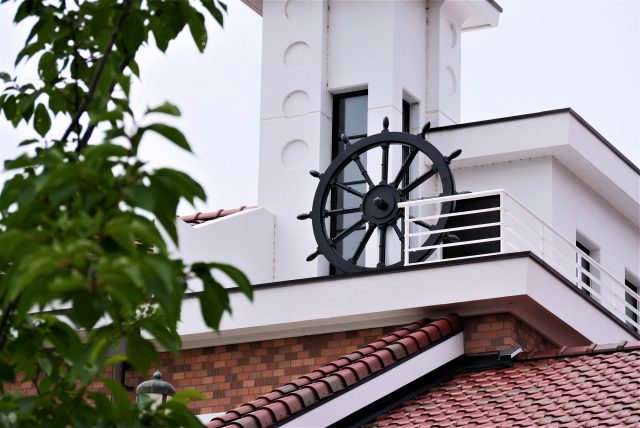
The Ship Wheel on the roof. (Photo courtesy of Panasonic Holdings)
Panasonic’s website says, “Society, economics, industry. In this multi-faceted era of change, Panasonic hopes to continue to be a company that contributes to the development of society. Panasonic Group will open a new era based on the business philosophy.” The spirit of Konosuke Matsushita lives on in the museum, showing how to steer the ship and open up a new future, like a ship sailing on a sea without a nautical chart.


